
Soccer and School: How Young Players Manage Both and What Actually Makes the Difference
Many families assume it’s a choice: soccer or school. It’s not. Thousands of young players manage both every year, not because they’re exceptional, but because they’ve learned to organize their time, stay disciplined, and keep going even when the schedule gets hard. This guide gives the practical methods that make it work: for the player, for the parents, and for families considering a structured environment like a soccer boarding school program. If you want to know whether your child has the right profile for that kind of program, our team will assess it for free.

Can you really do both?
Yes and the numbers back it up. Student-athletes in structured soccer programs consistently show academic results comparable to, or slightly above, national averages. The reason is counterintuitive. A packed schedule forces better time management. A teenager who knows practice runs from 3 to 6 PM can’t put homework off until tomorrow. It gets done tonight, or it doesn’t get done.
That said, balancing soccer and school doesn’t happen on its own. What separates the student-athlete who sustains it from the one who burns out is rarely raw talent or starting GPA : it’s personal motivation, self-discipline, and organization.
In the US, this balance plays out differently depending on the setup. Club soccer players at MLS Next or ECNL level are often training four to six times a week on top of a full school schedule, managing travel for showcases and tournaments, and handling college recruiting on the side. Residential soccer boarding schools in the US, Spain, France and England integrate training and academics into a single daily structure, which removes a lot of the logistical pressure. But the underlying habits are the same regardless of the setup.
The core habits of a student-athlete in a soccer boarding school program

1. The focus block rule
Twenty-five minutes of uninterrupted work beats an hour of distracted studying. For a young soccer player whose brain is still running plays on the way home from training, short, intense work blocks are far more effective than long revision sessions. The Pomodoro method with 25 minutes of work and 5-minute break, repeat fits this profile well.
In practice: two 25-minute blocks after dinner covers most of the daily workload for a middle schooler. A high schooler needs three to four. The rule: these blocks are non-negotiable. No phone, no notifications, no music with lyrics. This habit is set at the start of the season, not when the grades drop.
2. A shared family calendar
A shared calendar, paper or digital that includes both the soccer schedule and the school calendar, is the simplest and most effective organizational tool available. The goal isn’t parental control. It’s anticipation. A paper due Monday, a game Saturday, and a tournament Sunday: if nobody saw that coming two weeks out, the paper gets written Sunday night.
Families who handle the dual schedule well plan the hard weeks in advance and adjust expectations accordingly. During heavy competition stretches, academic expectations are scaled back, not dropped, but rationalized.
3. Using travel time
A competitive club soccer player often spends 30 to 60 minutes per trip between home, school, and training. That adds up to 5 to 10 hours per week, which is the equivalent of an extra study session. Vocabulary review, reading, educational podcasts, language apps: the tools for productive travel time exist. Building the habit early in the season requires almost no motivation. It just requires starting.
In a full-board residential program like those offered through Looking For Soccer, travel time disappears entirely. Everything is on campus or within 10 minutes. That time goes directly back into schoolwork or recovery. It’s one of the structural advantages of the residential model that’s easy to underestimate.
The parent’s role
Encouragement without pressure
This is one of the hardest balances for parents of competitive young players. Parental pressure, even well-intentioned, is one of the main drivers of burnout in adolescent athletes. A player who trains to please their parents, not for themselves, rarely holds up when the schedule gets genuinely hard.
The parent’s job is not to make decisions for the child or project their own ambitions onto them. It’s to communicate: to understand what the child is experiencing on the field and in the classroom, and to engage with their environment before judging their results. A parent who takes the time to understand why grades have slipped (fatigue, overload, a social issue) will always be more effective than one who reacts to the outcome alone.
Building a productive home environment
A productive environment means a dedicated workspace, away from screens, with school materials within reach. It also means meals together when possible, conversations about what’s happening in class as much as on the field, and a home where academics and soccer both have their place with neither crushing the other.
The daily habits that make it sustainable
Balancing soccer and school doesn’t depend only on the structure, whether that’s a local club, a high school varsity program, or a residential soccer boarding school program. It depends on consistent daily habits and regular check-ins that prevent overload and keep progress steady over time :
- Life balance first. Eating well, sleeping enough, and recovering properly are non-negotiable at high training volumes. Without adequate sleep and nutrition, both athletic and academic performance suffer. For young US players navigating early morning workouts, late practices, and weekend tournaments, this is often the first thing that slips.
- Open communication. Encouraging the player to talk to coaches and teachers early when something is off prevents small problems from compounding. Early communication almost always produces a simple fix. Waiting until the problem is visible rarely does.
- Discipline and routine. Small rituals like packing the bag the night before, blocking study windows in advance, keeping a consistent bedtime reduce mental load and build lasting routines. These are small things, but they’re the ones that make the pace sustainable over a full season.
- Fast, targeted academic support. When difficulties appear, move quickly: tutoring, makeup sessions, specific support. The goal is to prevent gaps from accumulating and to protect the player’s confidence. Letting a subject slide for a month in the middle of a tournament stretch is how players end up ineligible.
- Regular check-ins throughout the year. Frequent progress reviews between coaches, teachers, and parents allow training load and academic priorities to be adjusted as the season develops. Good monitoring is continuous, not just at report card time.
- Protecting adolescence. Discipline matters but the player is still a teenager. Downtime, weekends with the family, and genuine rest are essential for emotional stability and sustained motivation. Burning a 14-year-old out in pursuit of a college scholarship is a real risk in the US soccer ecosystem.
- Gradual progression, not sudden intensity. Building routines incrementally avoids overtraining and exhaustion. Goals are built through small repeated steps, not by trying to change everything at once.
- No procrastination. Handling small tasks immediately reduces stress and prevents work from piling up before a big game or showcase weekend. The sooner things are done, the less mental energy they cost.
- Taking care of the body. Hydration, appropriate nutrition, stretching, and injury management are long-term performance factors, not optional extras. A young player who neglects physical recovery usually ends up struggling with the pace before the season is over.
These small daily habits, maintained consistently, create the gap between the players who sustain the dual commitment and those who fall off. Consistency almost always beats intensity.
What soccer boarding schools actually build in to support your child
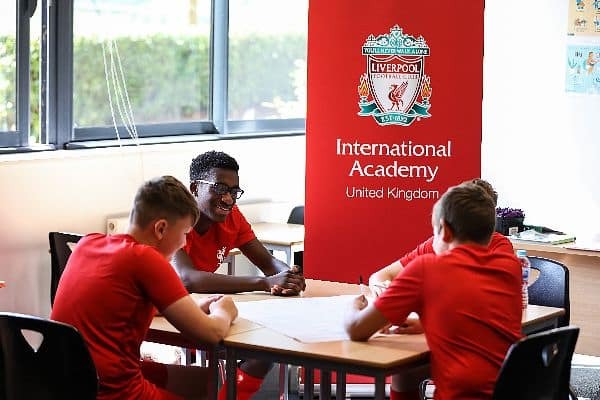
Managing soccer and academics at home, through a local club, takes an organizational effort that not every family can realistically sustain. That’s exactly why residential sport-études programs exist. They build the organization into the program itself.
Looking For Soccer’s partner academies all include structured academic support, integrated into the 10-month program:
- Enrollment in a partner private school or an online program with tutoring, depending on the academy and destination
- Intensive language courses depending on the program chosen
- Supervised study sessions built into the residential schedule
- Grade tracking and regular parent reports. Families know at all times where their child stands academically, not just athletically
- Dedicated study rooms in every residence, with WiFi and a proper working environment
This structure doesn’t replace the child’s motivation. But it removes from families the burden of organizing everything themselves, and from players the difficulty of self-disciplining in an environment that doesn’t always support it. Get support from our team to help your child access a sport-études program through Looking For Soccer.
One well-organized week changes everything
Balancing soccer and school isn’t about exceptional talent. It’s about method, routines built early, and a home environment that makes both possible at the same time. The players who do it aren’t different from the others. They’ve learned to work in short blocks, anticipate the hard weeks, use their travel time, and rely on parents who encourage without pressuring.
For families who want to go further and give their child a structure where all of this is already in place, our support for accessing sport-études programs is built exactly for that. Contact our team: we assess your child’s profile for free and guide you toward the most suitable program.
Frequently asked questions about finding balance between soccer and academics in a soccer boarding school program
Do grades really suffer when a player trains at a high level?
Not necessarily. Results from soccer boarding schools programs consistently show that players training intensively have academic outcomes comparable to national averages. The structure imposed by a dual schedule often becomes an academic advantage, not a handicap, provided the framework is solid and the player is genuinely motivated.
When should academics take priority over soccer?
Always, when grades drop significantly over several weeks. Soccer can wait for an exam or a revision period. School cannot because a failed grade is rarely as easy to recover from as a missed game. In every serious program, a player whose grades fall below minimum standards can be removed from the athletic track. That’s a protection rule as much as an expectation.
How do you manage school absences from games and travel?
Anticipation is the only effective answer. Notifying teachers in advance, getting missed material before the trip, and never waiting until after to catch up are the three rules that limit the impact of absences. In structured soccer boarding schools programs, this is managed by the academic team so the player doesn’t have to handle it alone.
Is a soccer boarding schools program right for every player?
No. A player without genuine personal motivation, or with significant pre-existing academic difficulties, risks falling behind on both sides. Soccer boarding schools programs are built for players who genuinely want both. If you’re unsure about your child’s profile, our team can work through that with you, for free and without any commitment.
Read next: