
World’s Best Soccer Academies 2027: Elite Year-Round Picks
MLS Next. ECNL. DA programs. College recruiting showcases. The American soccer development pathway is structured, competitive, and increasingly well-funded. And yet the players who dominate the World Cup, the Champions League, and the transfer market don’t come from it. They come from a handful of academies in Europe and South America that have spent decades perfecting what it actually takes to produce elite professional players. The question isn’t which club has the biggest budget. It’s which academies have the best system. Looking For Soccer, the reference platform for booking soccer camps at elite clubs, has ranked the world’s best soccer academies using the most objective data available: the January 2026 CIES Football Observatory report, which measures the number of trained players active in professional leagues worldwide, weighted by playing time and competitive level.

What is a soccer academy?
A professional soccer academy is a club-integrated structure that takes full responsibility for developing young players over multiple years, typically from age 11 to 18, combining daily training, adapted schooling, residential accommodation, and medical monitoring. The goal is to produce players capable of breaking into the first team or generating significant transfer fees. This is fundamentally different from a soccer camp, a soccer boarding school, or a private training center. To understand what that development pathway looks like at the highest level, read our guide on how professional soccer academies work.
How do you measure the world’s best soccer academy?
Every professional club has a youth program. Very few have a world-class soccer academy. Five criteria separate the best from the rest: consistent production over multiple decades, the level reached by alumni in professional football, transfer revenue generated, a clearly defined and transmissible playing philosophy, and infrastructure quality. The most objective current benchmark is the CIES Football Observatory, which publishes an annual global ranking of academies based on the number of trained players active in professional leagues worldwide, adjusted for competitive level and minutes played. Weekly Post 529, published in January 2026, is the most recent edition of this ranking and provides the backbone of this article.
| Club / Academy | CIES Ranking 2026 | Key philosophy | Notable alumni |
|---|---|---|---|
| SL Benfica (Benfica Campus) | No. 1 Worldwide (Global, 49 leagues) | Individual technical development and data-driven innovation | B. Silva, R. Dias, J. Félix, J. Neves |
| FC Barcelona (La Masia) | No. 1 Worldwide (Big 5 criterion) | Possession, pressing, collective intelligence | L. Messi, L. Yamal, Gavi, P. Cubarsí |
| Real Madrid (La Fábrica) | No. 2 Worldwide (Big 5 criterion) | Tactical flexibility, winning culture, mental strength | Raúl, I. Casillas, D. Carvajal, A. Hakimi |
| Paris SG (PSG Campus) | No. 3 Worldwide (Big 5 criterion) | Technical creativity, superior athleticism | K. Coman, M. Maignan, W. Zaïre-Emery |
| Stade Rennais | No. 4 Worldwide (Big 5 criterion) | Early development, explosive wing play, full academic integration | E. Camavinga, O. Dembélé, M. Tel, D. Doué |
| Ajax Amsterdam (De Toekomst) | No. 5 Worldwide (Big 5 criterion) | Total Football and the TIPS system | J. Cruyff, D. Bergkamp, F. De Jong |
| Chelsea FC (Cobham) | No. 6 Worldwide (Big 5 criterion) | Physical intensity, Premier League competitiveness, winning mentality | J. Terry, R. James, M. Mount, C. Gallagher |
| Manchester City (CFA) | Top 10 Worldwide (8th equal) | Positional play, spatial mastery, tactical intelligence | P. Foden, J. Sancho, C. Palmer, R. Lewis |
The world’s best soccer academies
1. Benfica Campus — SL Benfica
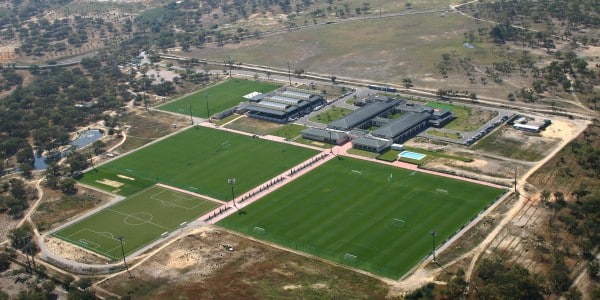
No club in the world has generated more transfer revenue from its academy over the last decade. Not Real Madrid. Not Barcelona. Benfica.
According to CIES Football Observatory Weekly Post 518, published in October 2025, Benfica ranks first globally with 93 academy-trained players currently active across 49 professional leagues worldwide. That’s more than any other club on the planet. A CIES study from April 2026 confirmed Benfica also leads the decade-long revenue ranking with 589 million euros generated through transfers of academy graduates. Among the alumnis, we’ve got Bernardo Silva, Rúben Dias, João Félix, João Neves, Gonçalo Ramos and Ederson. A list that adds names every season. The Seixal campus, opened in 2006, houses over 190 players across 9 pitches, with 80 full-time residents and 330 staff members working on-site daily. In 2025, Benfica won all three national youth titles in a single season: U15, U17, and U19.
2. La Masia — FC Barcelona

In 2010, the three Ballon d’Or finalists were all La Masia graduates. In 2026, 40 players trained there are active in Europe’s top five leagues. That number has never been higher.
According to CIES Weekly Post 531, FC Barcelona leads the Big 5 ranking with academy graduates under contract valued at a combined 738 million euros, which is the highest figure globally. Six of the eleven players aged 18 or under to start a LaLiga match this season play for Barcelona. That is not a coincidence. It is the output of a system that has stayed consistent across three distinct generations. The Cruyff era in the 1980s established the foundation: possession, pressing, collective intelligence. The Guardiola era between 2008 and 2012 brought it to a level the football world had never seen. The current generation proves the model regenerates. For the 2024-2025 squad, 18 of 34 players in the professional group had passed through La Masia. Lamine Yamal arrived at the club aged 7 and made his first-team debut at 15 years, 9 months, and 16 days, becoming the youngest player in Barcelona’s history. La Masia is now based at the Ciutat Esportiva Joan Gamper with 9 pitches, an integrated residence, and a dedicated school. The same 4-3-3 system, the same pressing philosophy, is taught from U9 to the first team without interruption. You cannot join La Masia without being scouted. But you can train in its environment. Looking For Soccer offers FC Barcelona camp in Barcelona for all levels, boys and girls. To understand what it takes to get into a professional academy, read our guide on how to get scouted for a professional soccer academy.
3. La Fábrica — Real Madrid
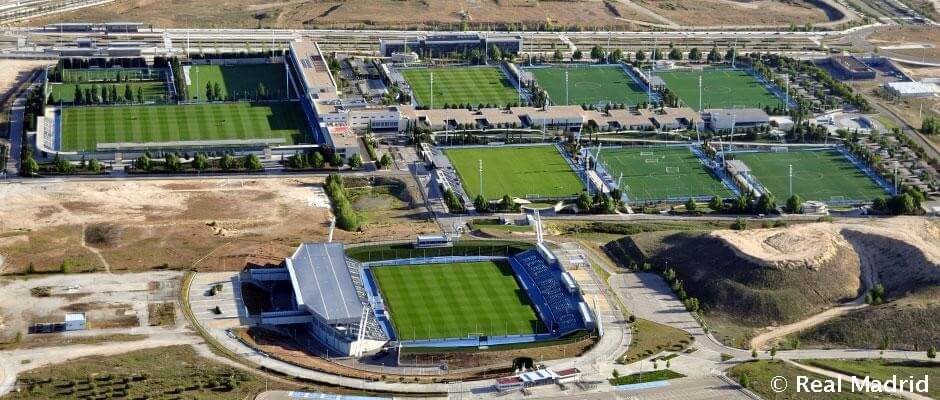
Raúl. Casillas. Carvajal. Valverde. Seventy years of history, one address: Valdebebas.
La Fábrica ranks second globally in the CIES Big 5 criterion, with 35 academy-trained players active in Europe’s top five leagues. Unlike La Masia, which develops players for a specific style of play, La Fábrica develops players capable of adapting to any system. That adaptability is the Real Madrid trademark. Raúl and Iker Casillas represent two decades of European dominance. Achraf Hakimi and Álvaro Morata were developed at Valdebebas before generating significant transfer fees on the market. Federico Valverde, one of the best midfielders in Europe today, joined the Real Madrid academy at 16 from Uruguay, which is a direct example of how La Fábrica reaches beyond Spain. Real Madrid is the only major club to have consistently fielded both world-class transfers and academy graduates in Champions League finals. La Fábrica houses approximately 360 young players across age groups, with many in full-time residence at the Ciudad Real Madrid facility in Valdebebas.
Important note: the camps available through Looking For Soccer are organized by the Real Madrid Foundation, the club’s charitable arm, not by the La Fábrica sporting department. These are two distinct structures. What you give your child is the Real Madrid environment, values, and infrastructure but not access to the professional academy. Looking For Soccer offers Real Madrid Foundation camps in Portugal for all levels.
4. PSG Campus — Paris Saint-Germain
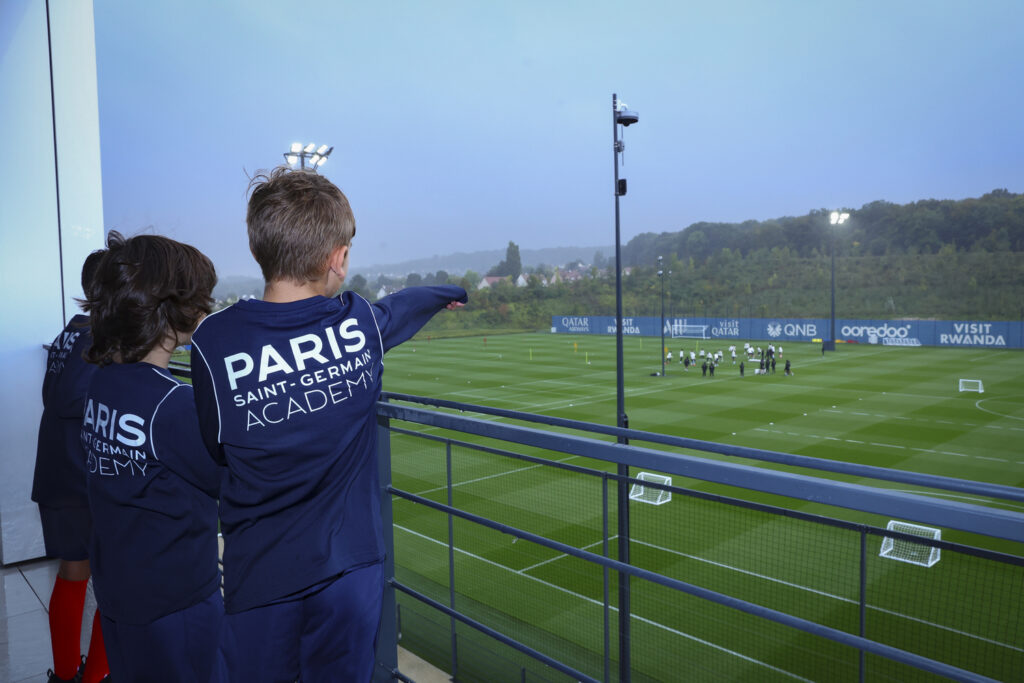
Warren Zaïre-Emery became the youngest player in PSG’s history at 16 years, 4 months, and 29 days. He won the Champions League with the club in 2025. He was born in Montreuil and trained at the PSG campus from age 6.
PSG ranks third in Europe in the CIES Big 5 classification, with 31 academy-trained players active in the top five leagues, which makes the club a figure that has remained stable over 1, 5, and 10 years. The campus, now at Poissy, has 14 pitches, a sports clinic, a 5,000-seat stadium, and its own school. 120 “Titis parisiens” have played in official PSG matches, 102 of them in Ligue 1. The current academy alumni list is one of the strongest in the world: Kingsley Coman, author of the winning goal in the 2020 Champions League final. Adrien Rabiot is a French international soccer player. Christopher Nkunku has been named best player in the Bundesliga in 2021-2022. In 2025-2026, PSG completed a historic treble, winning the professionals’ title, the U19 championship for the third consecutive year, and the U17 title. The PSG development model integrates both athletic and academic excellence at the highest level. Looking For Soccer offers PSG Academy camps for all levels at Poissy (Île-de-France) during summer vacations. Discover PSG Academy camps.
5. Stade Rennais Academy
The fourth-best academy in the world according to CIES 2026. Not Ajax. Not Chelsea. Not Manchester City. Rennes.
This is the ranking result that surprises most people and the one that best illustrates why France is the world’s dominant soccer nation right now. The Stade Rennais academy ranks fourth globally in the CIES Big 5 criterion with 29 players trained there active in Europe’s top five leagues. Four of the most valuable young players in European football (Eduardo Camavinga, Ousmane Dembélé, Mathys Tel and Désiré Doué) all developed in the same academy in the northwest of France.
6. De Toekomst — Ajax Amsterdam

In 1995, Ajax won the Champions League with a squad averaging 24 years of age and seven academy graduates in the starting eleven. Thirty years later, the world is still trying to copy their method.
Ajax ranks fifth globally in the CIES Big 5 criterion. Over 85 former academy players have represented the Dutch national team. Transfers of Ajax graduates have generated over 1.5 billion euros in total. The De Toekomst philosophy runs on the TIPS model: Technique, Intelligence, Personality, Speed. The same 4-3-3, the same pressing and possession system, is taught from U9 to the first team without interruption. This model directly influenced La Masia, the City Football Academy, and dozens of elite private academies worldwide. For American families, it is also worth noting that De Toekomst’s TIPS model influenced the U.S. Soccer Federation’s own curriculum reform in the 2010s.
7. Cobham — Chelsea FC
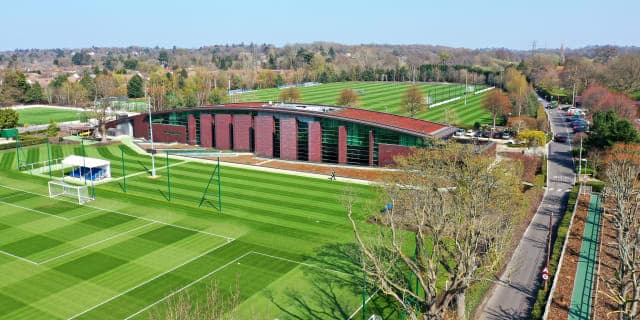
Cobham produced John Terry. It produced Reece James. In 2024, ten academy players made their first-team debut. No MLS Homegrown Player program has come close to those numbers at that level.
Chelsea ranks sixth globally in the CIES Big 5 criterion and third in Europe for decade-long transfer revenue from academy graduates: 442 million euros according to the CIES April 2026 study. In 2024, ten Cobham graduates made their Chelsea first-team debut, several becoming permanent members of Enzo Maresca’s squad. Chelsea’s approach is deliberately different from most top clubs: the entire project is built around internal promotion. The most valuable signing is often already in the building. In the context of American soccer development, Chelsea’s Cobham model is the closest parallel to what the EPPP system in England tries to achieve systematically for all Category 1 clubs. Looking For Soccer offers a Chelsea FC Foundation camp in Winchester, from development to intensive.
8. City Football Academy — Manchester City
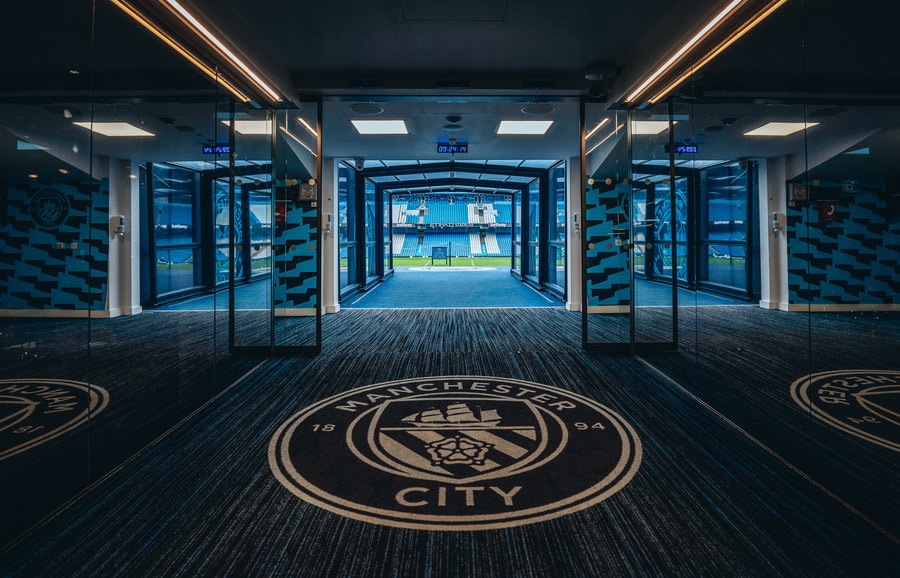
They developed Cole Palmer and sold him for 40 million pounds. He became Chelsea’s best player. Manchester City’s academy pipeline is now officially the most valuable in England.
Manchester City ranks in the global top 10, eighth equal according to CIES 2026. According to CIES Weekly Post 531, Manchester City leads the English rankings with academy graduates under contract carrying the highest combined transfer value of any English club. Phil Foden entered the academy at age 6, grew up a City fan in Stockport, won the U17 World Cup Golden Ball in 2017, and has now made over 300 appearances for the first team. Jadon Sancho left for Dortmund and returned to the Premier League via an 85 million euro transfer. Cole Palmer, sold for 40 million pounds, became one of the best performers in the entire Premier League. Jeremie Frimpong joined City at 9, left for Celtic at 18, developed at Bayer Leverkusen, and signed for Liverpool in May 2025. No MLS Homegrown Player transfer has approached these figures. The City Football Academy, adjacent to the Etihad Stadium, is one of the most modern facilities in the world. Pep Guardiola’s positional play model has been transmitted to the U9s. That same model now influences how coaches in the best soccer programs in England think about youth development. Looking For Soccer offers Manchester City camps for boys and girls, all levels. Discover the Manchester City camp.
Can my child train in these academies without being recruited?
Yes, partially. The professional academies themselves are closed to outside applications. Entry happens through scouting, after a player has been identified by club scouts. But the major clubs run parallel camp programs open to all, coached by the same educators and in equivalent facilities. That is precisely what Looking For Soccer curates and offers to families.
What to remember
The world’s best soccer academies are not judged on a single player or a single season. They are judged on decades of consistent production, a transmissible method, and alumni who continue to dominate professional football long after leaving the academy. Benfica, Barcelona, Real Madrid, PSG, Rennes, Ajax, Chelsea, and Manchester City each meet that standard, with different philosophies and different histories. What unites them is a shared conviction: the best players are built, not bought.
Frequently Asked Questions about the Best soccer academies in the world
What is the best soccer academy in the world?
According to the CIES Football Observatory January 2026 ranking, FC Barcelona leads the Big 5 criterion with 40 academy-trained players active in Europe’s top five leagues, and graduates valued at a combined 738 million euros. On the global criterion covering 49 professional leagues worldwide, Benfica leads with 93 active graduates. These two measures are complementary: Barcelona dominates European elite football, Benfica dominates in global volume.
How does a professional soccer academy work?
A professional academy takes players from approximately age 11 to 18, with a daily program combining soccer training, adapted schooling, and residential accommodation. Players are under contract with the club. For more detail, read our guide on how professional soccer academies work.
What age can my child enter a professional soccer academy?
In Europe, the standard entry age for certified academies is around 11 (U12 category). In some countries, pre-formation structures accept players from age 8 or 9. The most favorable window for scouting is typically between 11 and 14. Read our guide on what age to join a soccer academy.
What is the difference between a soccer academy and a soccer boarding school?
A professional academy is integrated into a club: players are under contract and the goal is to produce professionals for the first team or the transfer market. A soccer boarding school is a private structure combining intensive soccer and schooling, without a mandate to supply a specific club with players.
Can my child train at one of these academies without being recruited?
Not inside the professional academy itself. But the major clubs run parallel open camp programs coached by the same staff and using equivalent infrastructure. PSG, Manchester City, Chelsea, and FC Barcelona all offer these camps through Looking For Soccer.
Read next: