
Goalkeeper Physical Training: How to Develop the Key Qualities of the Position
Goalkeeper physical training is nothing like outfield conditioning. The position demands a very specific physical profile: explosive reactions, exceptional flexibility, and constant core stability combined with the ability to stay sharp through long stretches of inactivity. A keeper who trains like an outfield player will always be underprepared for what the position actually requires. This guide breaks down the physical qualities that matter most, a 4-week training program to build them, and the role that specialized goalkeeper soccer camps can play in accelerating that development.

Why Soccer Goalkeeper Training Is Different from Outfield Training
A goalkeeper covers between 5,000 and 6,000 meters during a match roughly half the distance of an outfield player. But within that distance, the intensity profile is completely different. Elite goalkeepers cover an average of 5,000 m during a game, of which as much as 68% is classified as low intensity, with only around 0.8% classified as high intensity such as sprinting and high-speed running. What this means in practice: a keeper can go 20 minutes without touching the ball, then face four shots in two minutes.
That profile demands a training approach built around three principles that differ sharply from outfield conditioning:
- Explosiveness over aerobic endurance. A goalkeeper doesn’t need a high VO2 max. They need to generate maximum force in 0.2 to 0.4 seconds. That’s a neurological and power-based demand, not a cardiovascular one.
- Flexibility as a technical skill. Diving to the post, stretching laterally, getting height on aerial balls mobility directly determines the range of saves a keeper can make. It’s not optional maintenance. It’s core technique.
- Constant core stability. Every intervention dive, catch, distribution, aerial contest requires the trunk to stabilize force transfer. A weak core means unstable saves, poor balance on distribution, and higher injury risk.
For the technical side of goalkeeping, our guide on goalkeeper training exercises covers 8 drills parents can work on with their child at home.
The Physical Qualities to Prioritize in Goalkeeper Training
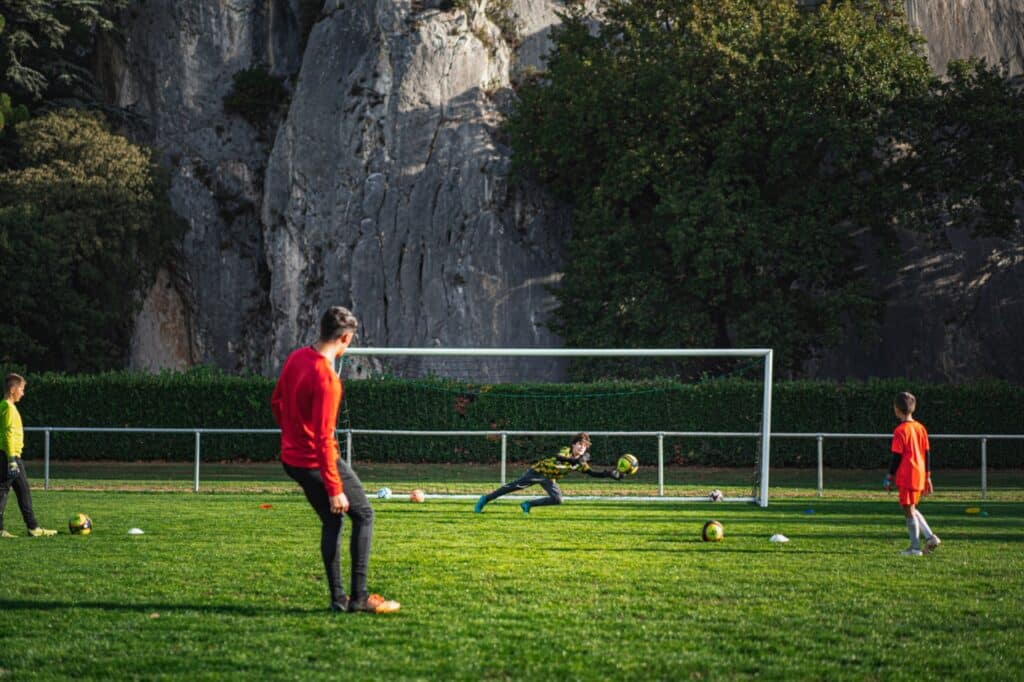
Not all physical qualities have equal impact on goalkeeper performance. Here they are in order of priority for the position.
1. Explosive power and reaction speed
A goalkeeper has an average of 0.2 to 0.4 seconds to react to a shot. Explosive power is the foundation of every save. It can’t be improvised it has to be trained. Plyometric jumps, short sprints of 5 to 10 meters, and reaction drills (responding to a visual or auditory signal) all develop this quality. Reaction speed is partly neurological: it improves with repeated exposure to position-specific stimuli, which is why game-realistic training beats generic conditioning drills.
2. Flexibility and joint mobility
A goalkeeper who lacks flexibility simply can’t cover the full goal area. Hip, shoulder, and spinal mobility determines dive amplitude. Ten minutes of active stretching and mobility work daily produces visible results within 4 to 6 weeks. Yoga and Pilates are recognized by professional goalkeeper coaches as effective complements to technical training. This is a quality that rewards daily consistency far more than occasional long sessions.
3. Core strength and functional stability
A strong core allows a goalkeeper to absorb physical contact during aerial duels, stabilize ball reception, and generate power in distribution. Deep abdominal muscles, lumbar muscles, and glutes form the base. Bodyweight exercises are sufficient to build this foundation: plank, side plank, glute bridge, single-leg squat. Upper body strength (push-ups, rows) improves handling quality and throw distance.
4. Coordination and balance
An unbalanced goalkeeper loses effectiveness on dives and aerial exits. Unstable surface training (balance board, BOSU), hand-eye coordination drills, and precise lateral movements all develop this quality. Good balance also improves game reading: a well-centered goalkeeper perceives trajectories earlier and reacts sooner.
5. Recovery capacity between efforts
A keeper needs to be as sharp on their 40th minute intervention as on their first. Short-interval training (maximum effort for 5 to 10 seconds, recovery of 30 to 60 seconds) directly replicates the goalkeeper’s match demand profile. Active recovery between sets (light movement, breathing, stretching) maintains quality across repetitions.
4-Week Soccer Goalkeeper Training Program
This program is designed to run alongside regular club training not replace it. Three specific sessions of 45 minutes per week, outside of team practices. Each week targets a priority quality while maintaining the gains from previous weeks. For the technical and tactical dimension, refer to our goalkeeper training exercises guide.
Week 1: Core strength and mobility foundations
- Warm-up: 10 minutes of joint mobility (hips, shoulders, ankles).
- Core circuit: front plank 3×45 seconds, side plank 3×30 seconds each side, glute bridge 3×15 reps.
- Active mobility: hamstrings, adductors, shoulders 2 sets of 30 seconds per muscle group.
- Cool-down: 5 minutes of controlled breathing and passive stretching.
Week 2: Explosive power and reaction
- Warm-up: 8 minutes of neuromuscular activation (jump in place, high knees, skipping).
- Plyometrics: squat jump 4×8 reps, split jumps 3×10 reps, lateral bounds 3×10 reps.
- Reaction: 5-meter sprint on visual signal (partner or thrown ball), 6 sets with 45 seconds recovery.
- Core maintenance: 2 sets of each Week 1 exercise.
Week 3: Functional strength
- Warm-up: full mobility sequence plus glute activation (resistance band).
- Upper body: push-ups 4×12, clap push-ups 3×8, Australian pull-ups 3×10.
- Lower body: single-leg squat 3×10 per leg, dynamic lunges 3×12, step-ups 3×10.
- Coordination: balance board exercises, single-leg landing after jump, 3×10 reps.
Week 4: Integration and match simulation
- Session 1: full circuit from weeks 1-3, 2 sets each, rest reduced by 20%.
- Session 2: match effort simulation 6 rounds of 90 seconds of intense effort (jumps, sprints, catches) with 2 minutes active recovery between each.
- Session 3: active recovery full mobility sequence, yoga or stretching, 20 minutes easy walking.
The Mental Dimension of Goalkeeper Fitness
Physical preparation and mental readiness are not separate for a goalkeeper. A missed dive after a recent error is rarely a fitness problem it’s usually a concentration or confidence issue. Conversely, a mentally strong keeper who is physically fatigued makes late decisions and arrives slow on the ball. The two reinforce each other: a keeper who has trained their physical reflexes approaches the match with more confidence; a keeper with strong mental routines recovers faster between intense efforts. For more on this, see our guide on mental preparation for goalkeepers.
How to Put This Physical Training Into Practice
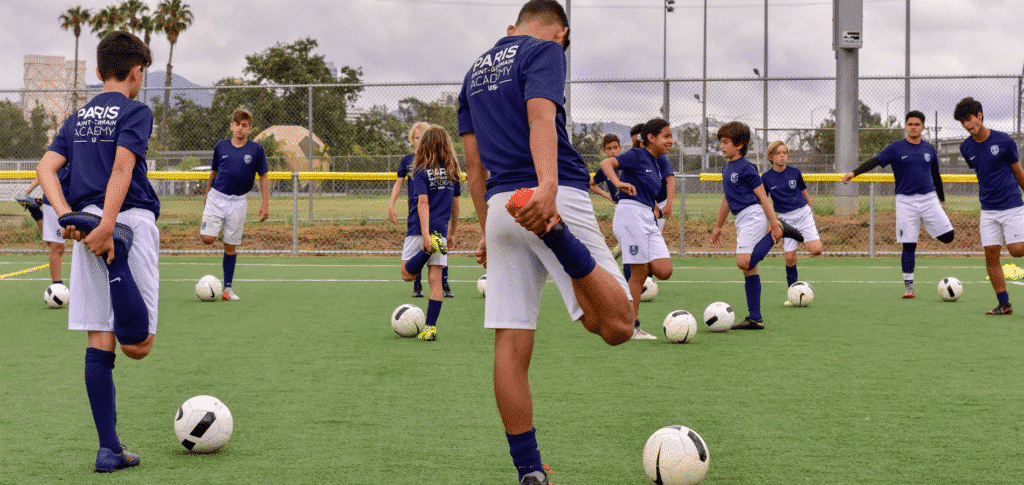
A training program on paper is only valuable if it’s actually put into practice. The good news is that a goalkeeper’s physical conditioning can be developed at various levels, depending on each person’s time, resources, and goals: at home with parents, at a club with a goalkeeper-specialized coach, or by joining an intensive soccer camp dedicated to goalkeeping.
A specialized goalkeeper camp is the option that packs the most into the shortest amount of time. In just a few days, a goalkeeper can work on their explosiveness, mobility, core strength, and coordination in an environment designed for that purpose, with coaches dedicated to the position, specialized equipment, and other goalkeepers who push the level higher. It’s not essential for progress. But it’s what really accelerates progress when the rest is already in place.
Looking For Soccer has selected goalkeeper camps at partner clubs equipped with professional facilities. Each program is evaluated based on the quality of coaching, the structure of the sessions, and the actual progress of the goalkeepers participating. Here’s what they offer in concrete terms on the physical level:
- Physical development integrated into the technical program. The training camps selected by Looking For Soccer do not separate physical conditioning from technical work. Explosive power is developed through real-life diving scenarios. Core strength is built through exercises that maintain stability under pressure. Mobility is improved in game situations, not just on a treadmill. It is this integration that makes physical gains directly transferable to match play.
- 100% specialized goalkeeper coaching. Whether it’s a camp entirely dedicated to the position or a program incorporating goalkeeper specialization, the instructors are experts in the physical demands specific to the role: working on reaction time, hand-eye coordination, and resistance to contact. These are not general soccer camps with a few goalkeeper exercises thrown in on the side. Every session is designed with the goalkeeper in mind, from the first warm-up exercise to the cool-down.
- Professional training conditions. Each camp takes place at partner clubs’ facilities. Goalkeepers train on the same fields and with the same equipment that professional teams use on a daily basis. This environment raises the bar for both standards and commitment: you don’t prepare the same way on a local field as you do at a professional club’s facilities.
The best goalkeeper soccer camps selected by Looking For Soccer are available across Europe. Check current availability and pricing directly on the site.
Physical Fitness Is Built Over Time: Start Now
A physically prepared goalkeeper makes better decisions, gets injured less, and performs at a higher level for longer. This type of position-specific training isn’t reserved for elite players it applies from the regional level up, with straightforward exercises and a progressive program.
To go further, a goalkeeper training camp offers a professional coaching environment in partner club facilities. And for a complete picture of goalkeeper development, our full guide to becoming a goalkeeper covers every stage of the journey.
Frequently Asked Questions
How often should a goalkeeper work on physical training?
Three specific sessions per week outside of team training is an effective baseline. During periods of heavy competition, two sessions are enough to maintain physical qualities without accumulating fatigue. Recovery is part of the program one session too many is worth less than one session done well.
Can explosive power be developed at any age?
Yes, at every age but the methods change. Before 14-15 years old, intense plyometric work is not recommended. The focus should be on reaction games, simple jumps, and coordination. From 15-16 onward, progressive plyometrics and position-specific strength work become fully effective. Goalkeeper camps through Looking For Soccer adapt the program to each keeper’s age and level.
Does flexibility actually improve with training?
Yes, with consistent daily work. Ten minutes of active stretching and mobility per day produces visible results in 4 to 6 weeks. Regularity matters far more than session length. A goalkeeper who stretches 10 minutes every morning develops faster than one doing an hour session once a week.
Does a goalkeeper need to use a gym for physical preparation?
Not necessarily. Bodyweight exercises are sufficient to build the functional strength base core stability, explosive power, coordination. Gym work adds an additional layer of progression for goalkeepers aged 16 and above. The sessions in this program require no equipment.
What is the difference between a goalkeeper’s physical preparation and an outfield player’s?
An outfield player primarily develops aerobic endurance, sustained speed, and repeated sprint ability. A goalkeeper works on explosive short-distance power, joint mobility, core stability, and reaction speed. The two positions share some exercises but the ratios and intensities are very different. For position-specific technical work to combine with this physical preparation, our goalkeeper training exercises guide covers the technical drills that complement this program.
Also read: