
Goalkeeper Positioning in Football: How to Cut Angles and Command Your Area
Good goalkeeping isn’t just about making saves. Most of the time, it’s about being in the right position so the save is straightforward. A goalkeeper with excellent positioning makes difficult shots look routine. A goalkeeper out of position makes routine shots look difficult. That’s the difference positioning makes. This guide covers the core principles of soccer goalkeeper positioning, how to cut angles effectively, how to handle set pieces corners, free kicks and penalties and the most common positioning mistakes keepers make at every level.

What is goalkeeper positioning in football ?
Goalkeeper positioning refers to where a keeper stands in relation to the ball, the goal and opposing players at any given moment during a match. Good positioning means the goalkeeper is always in the best place to reduce the angle for a shot, deal with a cross or organise the defence before the threat arrives, not after. It covers open play, set pieces and 1v1 situations. The best goalkeepers make saves look straightforward because their positioning has already done half the work.
The Principles of Good Goalkeeper Positioning
Every decision a goalkeeper makes about where to stand comes back to one question: how much goal am I leaving the striker to aim at? Good positioning answers that question before the shot is even taken. There are four core principles that underpin everything else :
Know where your goal is at all times
It sounds obvious. It isn’t. In the chaos of a game, keepers regularly lose track of exactly where they are in relation to their posts. Whenever play moves towards goal, the first thing a goalkeeper must do is check the posts to establish good position. Then, whenever they can divert their attention for a split second, they should check the posts again to make sure they’ve maintained that position. Make checking your posts a habit, not an afterthought.
Stay on the balls of your feet
A goalkeeper’s stance should be balanced, with weight evenly distributed on both feet. Stand on the balls of your feet to stay light on your toes, ready to move quickly. Knees should be slightly bent, allowing for agility and quick reactions. Keep your body low to the ground with your centre of gravity in the middle, prepared for dives or lateral movements. A flat-footed keeper is a slow keeper. It’s that simple.
Position relative to the ball, not the goal
Your position should shift constantly as the ball moves. Positioning yourself in relation to where the ball is on the pitch is vital. Too far back and you’re out of position to cut out a through ball. Too far forward and you risk being lobbed. When the ball is in the opposition’s half, a keeper can be well off their line up to the edge of their penalty area in some cases. As the ball moves into the final third, the keeper drops back progressively.
Communicate constantly
Positioning isn’t just about where you stand. Effective communication with defenders is crucial. Use vocal commands to direct defenders and coordinate the defensive effort. A goalkeeper who organises their defence well rarely needs to make reflex saves from close range, because the defensive shape is already doing the work.
Positioning and mental preparation go hand in hand. A keeper who second-guesses their position under pressure will always be a step slow. For the mental side of the position, see our guide on goalkeeper mental preparation.
How to Cut Angles Effectively
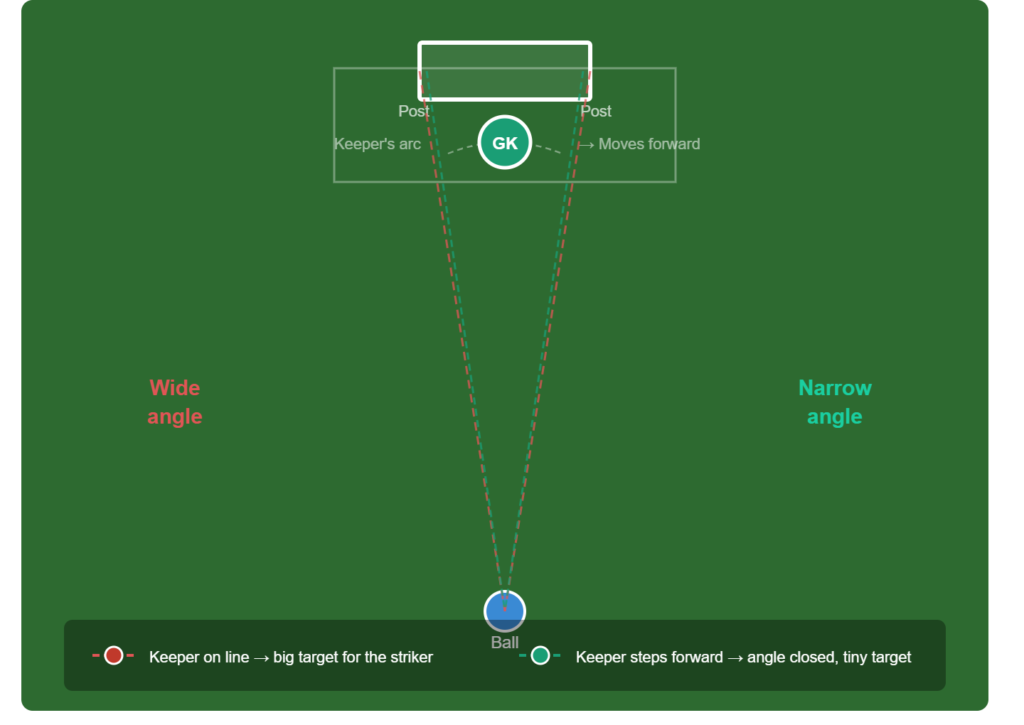
Cutting angles is the single most impactful positioning skill a goalkeeper can develop. A keeper who is always in position makes it look like every shot goes right to them, because the shooter has nowhere else to put the ball. Poor positioning leaves vast areas of net for a shooter or even an empty net.
The principle is straightforward. A regulation goal contains 364 football-sized spaces from post to post, floor to crossbar. Once you add the goalkeeper, you reduce the number of shooting pathways. If the goalkeeper’s position is perfect, you can reduce even more balls from entering the goal. The goal appears smaller with proper positioning and angle play.
To cut angles correctly, a keeper must:
- Move towards the ball, not stay on the line. Coming off your line narrows the angle. Use an imaginary arc to get a good start position. The arc should only go to three yards off the line. Hold your ground and transfer pressure to the striker make the striker beat you.
- Keep the bisector line through the legs. Imagining that a piece of string runs straight from the middle of the goal, through the goalkeeper’s legs and to the ball is a good guide to positioning at the angle.
- Don’t overcommit. Advancing down the line only reduces reaction time and opens the goal if the ball is cut back or passed across. There’s a balance between narrowing the angle and leaving yourself exposed.
- Stay set before the shot. Moving as the striker shoots means your weight is in the wrong place. Get to your position early, set yourself, then react.
Goalkeeper Positioning on Set Pieces
Set pieces are where games are won and lost. Roughly a third of all goals in professional football come from set pieces corners, free kicks and penalties. A goalkeeper’s positioning in these moments is non-negotiable. There’s no excuse for being caught out by something that can be prepared for in training.
Positioning for corners
Positioning on corners is vital. A goalkeeper must be prepared to deal with a corner by either coming to claim the cross, saving an attempt at goal or instructing defenders to clear the ball, whilst getting into position in anticipation of any further threat.
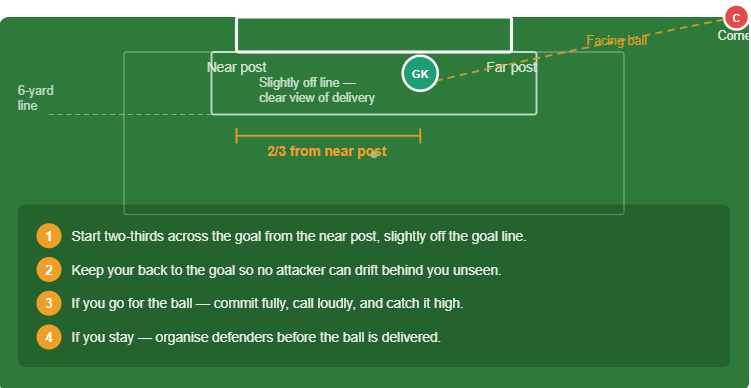
For a corner from the right, the starting position should be just off-centre towards the back post, on roughly a 45-degree angle. Position yourself just off centre towards the back post on a 45-degree angle so that you can see the ball and also any players around you. This gives you sight of the delivery and the momentum to attack the ball if needed.
Here are the key goalkeeper positioning for corners principles every keeper should know:
- Start on the six-yard line, roughly two-thirds of the way across the goal from the near post.
- Keep your back to the goal don’t let players drift behind you unseen.
- Claim early and loudly. If you’re going, commit. Don’t hesitate.
- If you’re staying on your line, organise your defenders to deal with the initial delivery.
- Stay alert for the second ball. If the corner is cleared, reset your position immediately.
Positioning for free kicks
A free kick near the box gives a goalkeeper three things to manage simultaneously: the wall, their own position and any runners making late moves.
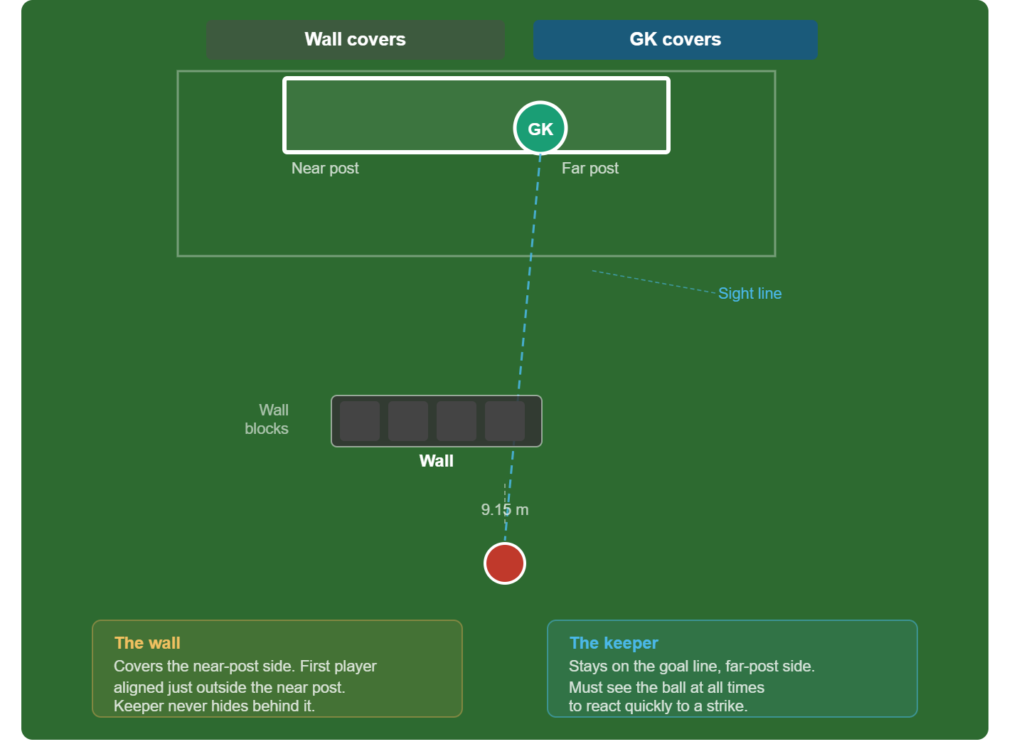
The goalkeeper positions the first person in the wall just outside the front post. The keeper has positioned themselves just past the last person on the wall, enabling them to see the ball. The striker has very little of the goal to aim at, and it would take a brilliant strike to score.
Goalkeeper positioning free kick situations require three different setups depending on where the ball is placed:
- Central free kick: Wall covers the near post side. Keeper covers the far post side, positioned to see the ball around the edge of the wall.
- Wide free kick (inswinger): No wall needed. Keeper positions towards the near post to deal with the inswinging delivery or cut it out early.
- Wide free kick (outswinger): Keeper adjusts towards the back post, ready to deal with a ball that may be attacked by an onrushing forward.
The goalkeeper must also take into consideration the conditions they are playing in: the wind and its direction or strength, where the defensive line is positioned. Will this make their job easier or harder in dealing with this free kick? Elite keepers factor in the weather. Most youth keepers don’t.
Positioning for penalties
The penalty is the situation where goalkeeper positioning matters least and psychology matters most. The keeper must be on their line until the ball is struck. But there’s still a positioning game to play.
- Start centrally. Do not cheat to one side early a sharp penalty taker will go the other way.
- Read the run-up. The angle of approach and the placement of the non-kicking foot often telegraph direction. Trust your preparation, not your instinct in the moment.
- Be big. Spread your arms slightly, stay tall, make the goal look as small as possible. Aiming for the corners of the goal makes it more difficult for the goalkeeper to save the shot. Make those corners feel far away.
- Commit late. The later you dive, the harder it is to be sent the wrong way.
Goalkeeper Positioning Diagram: Reading the Game Visually
One of the most effective goalkeeper positioning tips any coach can offer is this: before every session, study the pitch from above. Most keepers think about positioning from their own point of view what they can see from where they’re standing. The best keepers also think about it from a bird’s-eye view, understanding how their position looks from the striker’s perspective and from the coach’s perspective.
A simple goalkeeper positioning diagram divides the pitch into thirds and maps the keeper’s correct position for each:
- Ball in the opposition half: keeper can be beyond the penalty spot, commanding a high line.
- Ball in the middle third: keeper drops to between the penalty spot and the six-yard box.
- Ball in the final third: keeper is between the six-yard box and the goal line, ready for a shot or cross.
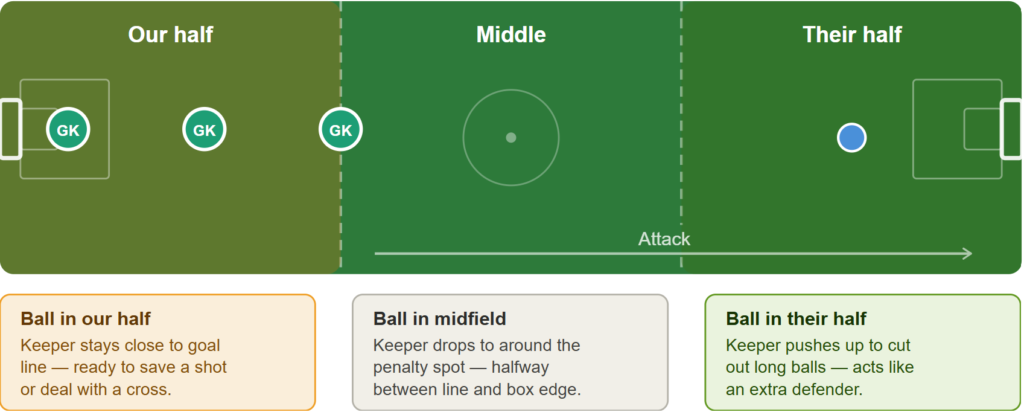
These aren’t rigid zones. They’re starting references. As a keeper develops, their positioning becomes more instinctive but it should always be backed by the same underlying logic: maximise coverage, minimise reaction time, give the striker nothing to aim at.
Common Positioning Mistakes and How to Fix Them
Most positioning errors come down to a handful of habits that are easy to identify and correct with the right coaching. Here are the most common ones seen at youth and amateur level.
- Hugging the goal line. The most common mistake. A keeper glued to their line gives the striker the whole goal to aim at. Fix it: work on coming off the line to narrow angles in training, with a coach or partner checking your position.
- Overcommitting in 1v1s. Advancing down the line only reduces reaction time and opens the goal if the ball is cut back or passed across the goal. Hold your shape and let the attacker make the decision.
- Losing track of the posts. Especially common after a scramble or a set piece. Make a habit of touching the post to reset your reference point.
- Flat feet between plays. A keeper who doesn’t stay on the balls of their feet will always be half a step slow. Standing on the balls of the feet keeps the keeper light on their toes and ready to move quickly.
- Not setting before the shot. Moving laterally as the ball is struck splits your weight and reduces your reach. Get to your position, set yourself, then save.
- Poor communication on crosses. Indecision between goalkeeper and defenders is what creates dangerous situations. Command your area early and loudly. Claim early and loudly. If you’re going for the ball, commit. Hesitation leads to goalmouth scrambles.
Positioning errors are often physical as much as tactical. A keeper who lacks explosiveness is late to their spot. A keeper with poor core strength loses balance on contact. For the physical side of development, see our guide on goalkeeper physical preparation.
Good Positioning Starts on the Training Pitch
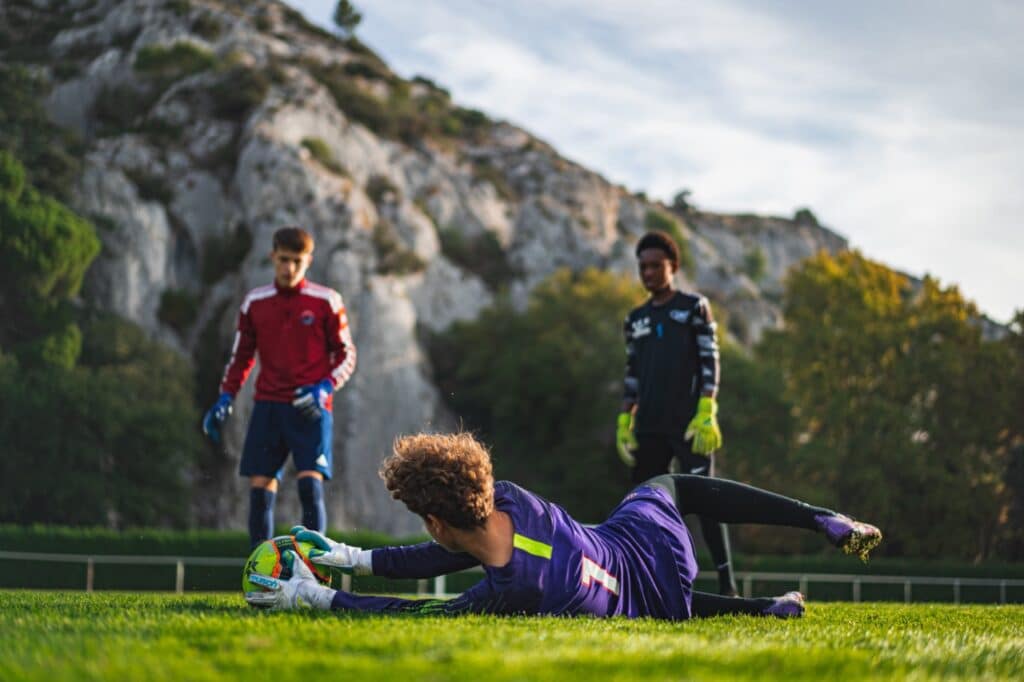
Reading about positioning helps. Practising it under pressure is what makes it stick. The habits described in this guide coming off the line, checking the posts, setting before the shot, communicating on crosses only become automatic when they’re trained consistently, with immediate feedback from a specialist coach.
Looking For Soccer’s goalkeeper camps provide exactly that environment. Here’s what sets us apart :
- Goalkeeper-specific coaching from day one. Every camp on our website is either entirely dedicated to goalkeepers or includes a structured goalkeeper specialisation track. The coaches are position specialists. They understand the mechanics of angle play, the footwork patterns for set pieces, and the decision-making demands of a 1v1. That’s not something you find in a general football camp where a keeper might get 20 minutes of dedicated work per session.
- Professional club facilities. All Looking For Soccer partner camps are hosted at professional club facilities. Keepers train on the same pitches, with the same equipment, in the same conditions as the professional squads that use them every day. That environment raises the bar. Players concentrate differently, compete more intensely, and hold themselves to a higher standard when the setting demands it.
- Positioning built into every session. Goalkeeper positioning isn’t a standalone drill in Looking For Soccer programmes : it runs through everything. Angle play is practised on shots, set piece positioning is rehearsed in match scenarios, and positioning errors are corrected in real time by coaches who know exactly what to look for. That integration is what makes technical improvements transfer into match performance.
- A rigorously curated catalogue. We only lists camps that meet strict quality standards. Every partner programme is evaluated on coaching quality, session structure, and the genuine progression of the goalkeepers who attend. That selection process is what gives families confidence they’re booking something that will actually make a difference, not just fill a week of the holidays. Browse our goalkeeper camps to find the programme that fits your child.
The Best Goalkeepers Never Stop Working on Their Positioning
Positioning isn’t a skill you master once and move on from. It evolves with every phase of a goalkeeper’s development, from learning the basics of angle play at youth level to reading the game instinctively as an adult. The principles in this guide are the foundation. Building on them takes consistent, quality practice in the right environment.
Whether your son or daughter is just starting out in goal, working through their development years, or serious about reaching the highest level they can, Looking For Soccer has a programme for that stage. Our goalkeeper camps are selected to give keepers the coaching, facilities, and competitive environment they need to genuinely move forward. And for the technical and physical foundations that complement positioning work, our guides on goalkeeper training and goalkeeper physical preparation cover everything else.
FAQ
What is the correct goalkeeper positioning in football, and what does positioning goalkeeper well actually mean?
There’s no single correct position it changes constantly based on where the ball is. The fundamental principle is to narrow the angle between yourself and the likely shooting direction, stay off your line to reduce the target area, and keep your weight on the balls of your feet ready to move. Position relative to the ball, not the goal.
How does a goalkeeper cut angles effectively?
By moving off the goal line towards the ball to reduce the visible target. The further a goalkeeper comes off their line (within reason), the less goal the striker can see. The key reference is the bisector line an imaginary line from the centre of the goal through the goalkeeper’s body to the ball. When the keeper is on this line and appropriately off their line, their angle play is correct.
What are the best goalkeeper positioning drills?
The most effective drills replicate match situations: shots from various angles with the keeper starting in different positions, set-piece simulations for corners and free kicks, and 1v1 exercises at different distances. Drills that use gates or markers to define correct position give the keeper immediate visual feedback on whether they’re in the right spot.
Where should a goalkeeper stand for a corner?
For a corner from the right, start just off-centre towards the back post on roughly a 45-degree angle. This gives you sight of the delivery and the ability to attack the ball if needed. Keep your back to the goal so you can see any players drifting into dangerous areas. Organise your defenders with clear, early calls.
Where should a goalkeeper stand for a free kick?
For a central free kick with a wall, position yourself just beyond the last player in the wall so you can see the ball. The wall covers the near-post side; you cover the far-post side. For wide free kicks without a wall, adjust your position based on whether the delivery is an inswinger or outswinger. Always factor in wind conditions.
What are the most common goalkeeper positioning mistakes?
Staying too close to the goal line, overcommitting in 1v1 situations, being caught flat-footed, not resetting position after a set piece, and failing to communicate early on crosses. All of these are fixable with deliberate practice and quality coaching. A goalkeeper camp focused specifically on positioning like those offered through LFS is one of the fastest ways to correct these habits.
Also read :