
Football Strength Workout for Young Players: No Equipment Needed
You don’t need a gym or specialist equipment to make real physical progress on the pitch. Bodyweight strength training, done properly, is enough to build explosiveness, stability, and injury resistance in a young football player. This guide, brought to you by Looking For Soccer, the reference platform for booking football camps at elite clubs, breaks down a complete football strength workout to do at home or on the pitch, with no equipment required. To understand why this work is one of the pillars of injury prevention, see our guide to common football injuries.

Why does strength training matters for young footballers ?
Strength training isn’t reserved for elite athletes or regular gym-goers. An age-appropriate programme directly improves three things on the pitch: explosiveness in sprints and jumps, stability in 1v1 duels, and resistance to the most common football injuries.
Targeted strengthening hamstrings, adductors, ankles ranks among the most effective preventive investments a young player can make to reduce the risk of muscle strains and ankle sprains. A player who skips this kind of physical preparation falls behind in ways that ball work alone won’t fix.
Before you start: the ground rules
- Frequency depends on age. Between ages 10 and 13, two short 15-20 minute sessions a week are enough, with the focus on technique rather than intensity. From age 14 onwards, volume can increase to 2-3 sessions of 20-30 minutes, alongside regular football training.
- Warming up isn’t optional. 5 to 10 minutes of joint mobility and a gradual rise in body temperature before each session significantly reduces injury risk during the workout itself.
- Technique always comes before load. A poorly executed exercise doesn’t strengthen the right muscle and can create dangerous compensation patterns. For a young player, the priority is learning correct movement before increasing reps or intensity.
The football strength workout (no equipment)
Leg strength and explosiveness
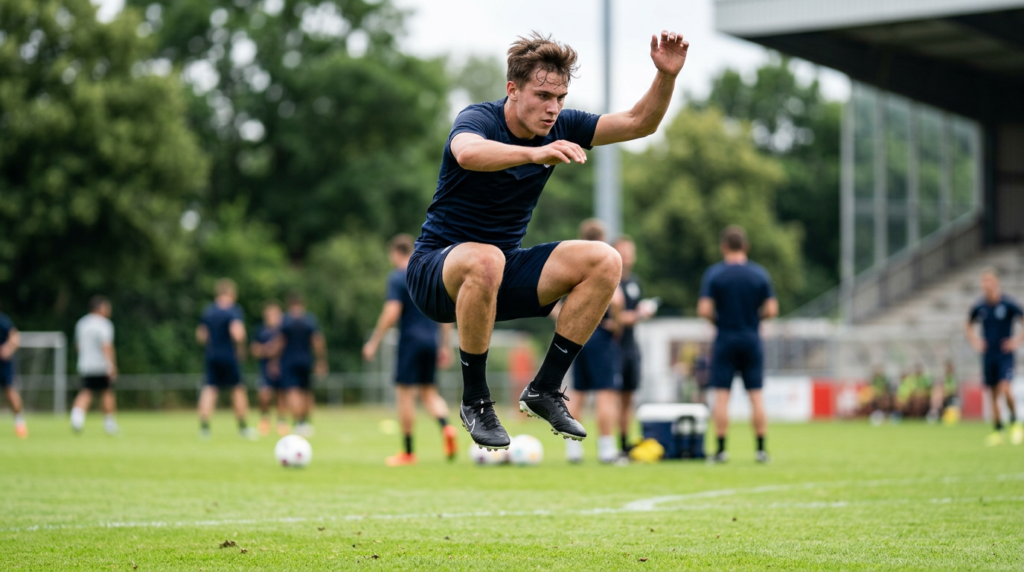
Legs are the engine of the game sprinting, shooting, changing direction. Three exercises are enough to build a solid base:
- Bodyweight squats: 3 sets of 12-15 reps, controlled descent, knees tracking over toes
- Alternating forward lunges: 3 sets of 10 reps per leg, upright torso, back knee close to the ground without touching
- Jump squats: 3 sets of 8-10 reps, soft landing on the forefoot an explosiveness exercise to introduce only once the standard squat is mastered
Core strength and stability
Core strength stabilises the hips and trunk vital for shooting power and balance in duels. The core is one of the most overlooked areas in amateur physical preparation.
- Plank: 3 sets of 30-45 seconds, body aligned from head to heels, avoid arching the lower back
- Side plank: 3 sets of 20-30 seconds per side, hips lifted and stable
- Mountain climbers: 3 sets of 20 reps (10 per leg), controlled pace rather than fast and sloppy
Hamstrings and ankles targeted injury prevention
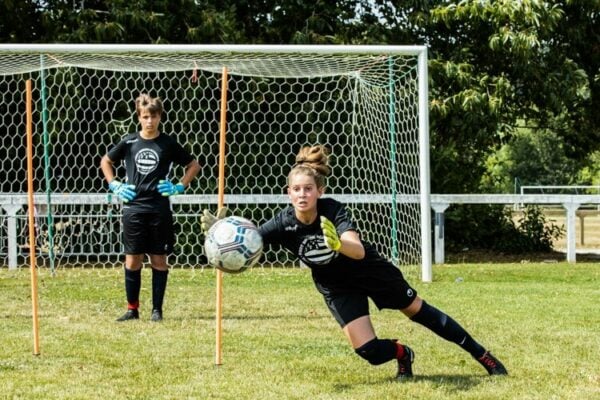
These are the two most commonly injured areas in football, particularly ankle sprains and hamstring strains, which together account for more than a third of injuries in young players. Strengthening these areas is likely the highest-return segment of this entire programme.
- Nordic hamstring curl (beginner version with a partner): 3 sets of 5-6 reps, slow controlled descent the gold-standard exercise for preventing hamstring strains
- Glute bridge: 3 sets of 12-15 reps, maximum contraction at the top of the movement
- Single-leg balance (ankle proprioception): 3 sets of 30 seconds per leg, eyes open then closed to progress
Upper body and stability
Often overlooked in football, upper body strength still plays a role in shielding the ball, aerial duels, and overall stability. No need for intensive work, just consistent maintenance.
- Press-ups (knees down if needed): 3 sets of 8-12 reps, core braced throughout the movement
- Supermans: 3 sets of 12 reps, controlled raise of opposite arm and leg
Sample football strength workout (20-30 minutes)
This session follows a circuit format. The player moves through each exercise with 30 to 45 seconds of rest in between, and repeats the circuit 2 to 3 times depending on their level:
- The player warms up for 5 to 8 minutes with mobility work and a gradual build-up in intensity.
- They perform 12 to 15 bodyweight squats.
- They hold a plank for 30 to 45 seconds.
- They complete 10 alternating forward lunges per leg.
- They perform 12 to 15 glute bridges.
- They hold a side plank for 20 to 30 seconds on each side.
- They complete 8 to 12 press-ups.
- They hold their balance on one leg for 30 seconds on each side.
- They finish the session with a 5-minute cool down of light stretching.
Mistakes to avoid during a strength training session
- Loading up too early. Adding weight or intensity before mastering technique is the most common cause of strength-training-related injuries in young players.
- Skipping the warm-up. Cutting this step to save time actually multiplies injury risk during the session itself the opposite of the intended effect.
- Copying an adult programme. A programme built for a professional player isn’t suited to a growing body. Volume and intensity need to be scaled to age and level.
- Overtraining. More isn’t always better. A body that doesn’t recover between sessions builds up residual fatigue, which increases injury risk rather than reducing it. It’s also something scouts pay attention to, as covered in our article on football scouting a player who’s physically run down attracts less attention.
How does Looking For Soccer builds strength training into its programmes ?
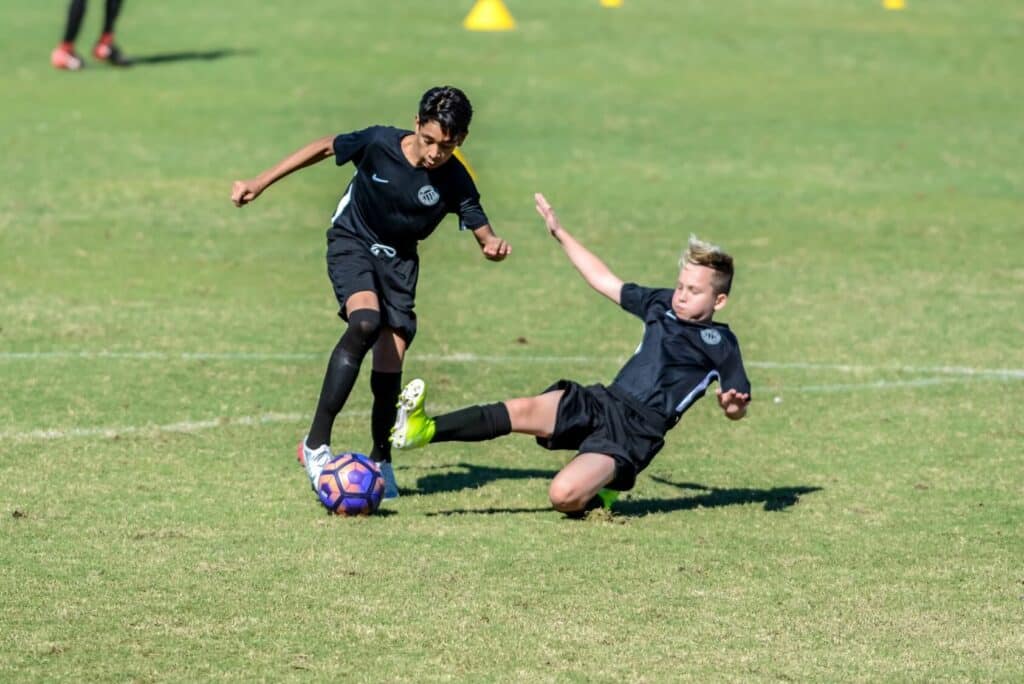
Whether it’s a one-week camp or a 10-month football boarding school programme, strength training is a core part of every Looking For Soccer partner programme. The best programmes deliver structured physical work scaled to each player’s age and level not a copy-paste of adult sessions.
For families who want their child training in an environment where physical preparation is taken seriously, our intensive camps consistently build in strength sessions led by certified coaches.
Frequently Asked Questions about Football strength training
At what age can kids start strength training for football?
Bodyweight strength training can start as early as 8-10 years old, framed as play and focused on movement technique. External loading (dumbbells, machines) is generally not recommended before age 14-15, once bone growth is sufficiently advanced.
How many times a week should you do strength training?
Two to three sessions of 20-30 minutes per week, alongside football training, are enough to make real progress without overtraining. Consistency matters more than volume two sessions a week sustained over several months beats an intense programme that gets abandoned after two weeks.
Does strength training stunt growth?
No, that’s a myth. Bodyweight strength training, done properly and scaled to age, doesn’t stunt growth if anything, it strengthens bone and tendon structures and reduces the risk of growth-related injuries like Osgood-Schlatter disease. Proper nutrition, as covered in our guide to nutrition for young footballers, also supports this stage of development.
Can bodyweight training replace a gym session?
For a developing young player, yes, in most cases. Bodyweight work is enough to build the functional strength football requires up to an advanced level. External loading becomes relevant later, typically around sixth-form age or at an academy, under the supervision of qualified strength and conditioning coaches.
Also read: