
Goalkeeper Mental Preparation: How to Perform When It Matters Most
One save can win a match. One mistake can cost it. For a goalkeeper, that mental weight never lifts, even when the ball is at the other end of the pitch. Technical ability only takes you so far. When the pressure peaks, it’s mental preparation that separates the goalkeepers who hold firm from those who crack. This guide covers the key techniques to develop the mental side of goalkeeping, a structured 4-week programme to run alongside regular training, and the specialist goalkeeper football camps selected by Looking for Soccer where you can put it all into practice.

Why Mental Preparation Is Different for Goalkeepers
No outfield player faces the same mental demands as a goalkeeper. You spend the majority of a match as a spectator. Then, in a fraction of a second, the whole game can depend on you. That combination of prolonged inactivity and explosive decision-making creates a psychological environment unlike any other position on the pitch.
Three things define the goalkeeper’s mental load:
- Mistakes are immediate and visible. A midfielder can recover possession. A goalkeeper very rarely gets a second chance.
- Decisions happen in isolation. There’s no teammate close enough to share the responsibility.
- Concentration must never drop. Even when the play is camped in the opposition half, a goalkeeper who switches off is a goalkeeper who gets caught.
FIFA coaching guidelines identify three core pillars of goalkeeper mental preparation: visualisation, attention management, and mental imagery. These are not abstract concepts. They are applied techniques used at the highest levels of professional football. For the technical and physical dimensions of the position, see our full guide on goalkeeper training.
The Mental Qualities Every Goalkeeper Needs to Develop
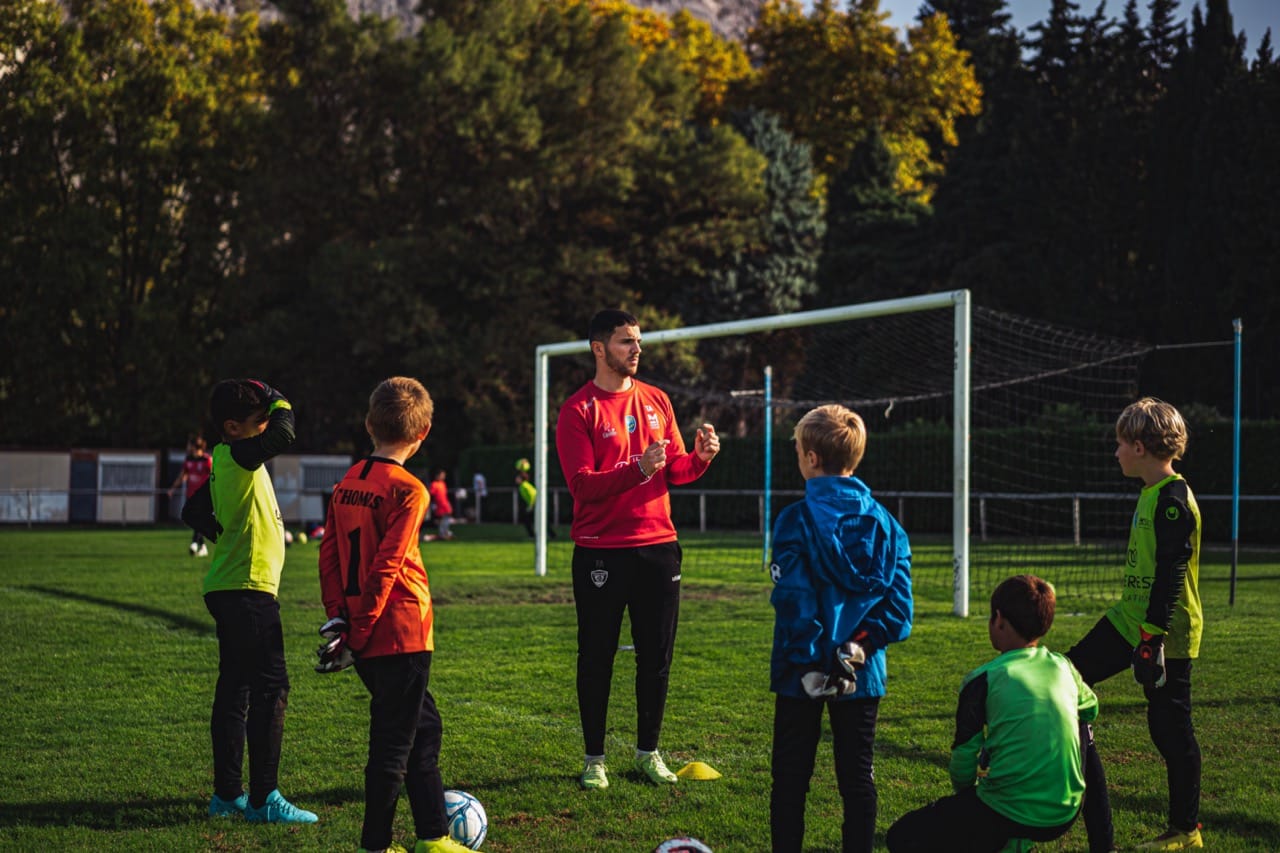
Beyond shot-stopping and distribution, this is what top coaches and scouts are actually looking for:
- Selective focus. The ability to filter what matters : ball flight, attacker movement, defensive shape and ignore crowd noise, past mistakes, and scorelines.
- Resilience. Conceding a goal or making an error doesn’t affect the next intervention. The goalkeeper resets, he does not ruminate.
- Situational confidence. Belief in their own ability at the moments of highest consequence: penalties, set pieces, one-on-ones.
- Composure. Emotional steadiness in decisive passages of play, not detachment, but control.
- Defensive leadership. Organising the back line, communicating clearly under pressure, and commanding the penalty area. This demands mental clarity first.
Research from the University of Lille (2021) found that 70% of athletes who consistently integrate mental preparation techniques show measurable gains in concentration and stress management during competition.
Mental Preparation Techniques That Work
Handling Pressure and Recovering from Mistakes
Every goalkeeper concedes. Every goalkeeper makes errors. What the best in the world do differently is recover faster and more completely.
The most widely used tool in professional goalkeeper coaching is the mental reset. It follows three steps:
- A personal physical trigger: clapping gloves, touching the post, three controlled breaths.
- A short internal anchor phrase: “done, I’m here” or “next save”.
- Immediate redirection of focus toward the next moment of play, not toward what just happened.
Controlled breathing reinforces this. A 4-count inhale followed by a 6-count exhale, repeated three times, takes under 90 seconds and measurably reduces nervous system activation. It can be used mid-match, before a penalty, during an opposition free kick, after conceding.
Internal dialogue plays an equally direct role. “I can’t afford to miss this” tightens muscles and delays reaction. “I’m going right” prepares the body to act. The language used internally shapes the response physically.
Concentration and Match Routines
Concentration is not an on/off switch. It’s an activation level that fluctuates across 90 minutes. The goalkeepers who perform consistently late in matches are not those who tried to maintain peak focus throughout. They are those who learned to manage when and where to switch it on.
Match routines make that possible. They create a reliable pathway to optimal mental readiness without depending on motivation or mood. A well-structured routine covers three phases:
- Pre-match: 10 minutes of visualisation covering likely scenarios. A chosen playlist to reach the right activation level. A warm-up routine that never changes, because consistency creates a mental trigger.
- In-match: tracking the ball even when it’s distant; talking to defenders to stay mentally engaged; a deliberate breath during every goal kick.
- Post-incident: apply the mental reset; return to position; re-establish eye contact with the defence to reassert command.
A goalkeeper who locks in consistent routines doesn’t just have one good game. They raise their floor across an entire season.
Visualisation
Visualisation is the most thoroughly researched mental preparation method at elite level. INSEP studies indicate that athletes who practise it regularly improve their performance on targeted actions by around 15% on average.
For a goalkeeper, this is not about running through an entire match in the mind. It’s about drilling specific high-pressure scenarios:
- Saving a penalty: reading the striker’s body shape, deciding on a side before the run-up ends, committing to the dive.
- Claiming an aerial ball: the timing of the jump, the position of the hands, securing under pressure.
- Recovering after conceding: resetting emotionally, stepping back into the leadership role immediately.
- Organising a defensive wall: reading the likely trajectory, positioning, adjusting in real time.
The more sensory detail the visualisation contains. The feel of the gloves, the noise of the Kop, the ground pressure on landing, the more powerfully it conditions the nervous system. Ten focused minutes the evening before a match is worth more than an hour of passive mental drifting.
Mental imagery extends this further by adding emotional context: the scoreline, the crowd, the stakes. Using both in combination is the approach advocated by leading performance coaches at professional clubs.
4-Week Mental Training Programme
This programme slots in alongside your existing club schedule. It does not replace technical or physical work : it completes it. Allow 10 to 15 minutes per day.
Week 1: Lay the Foundations
- Daily: 5 minutes of controlled breathing (4-count in, 6-count out, 10 cycles).
- The evening before each training session: 5 minutes visualising a successful penalty save.
- After each session: write one thing handled well mentally in a performance journal.
Week 2: Build Concentration
- Daily: visual focus drill. Hold a fixed point for 2 minutes, then progressively widen peripheral awareness.
- At every training session: apply the mental reset after every goal conceded, including in practice matches.
- The evening before each match: run through 3 separate scenarios (penalty, aerial claim, free kick).
Week 3: Manage Pressure
- Establish a personal reset signal and use it consistently at every session.
- Audit internal dialogue: convert each negative thought into an action-focused phrase.
- Simulate pressure with your coach: back-to-back penalties, set pieces under physical fatigue.
Week 4: Embed and Stabilise
- Build out a complete match routine covering the evening before, the morning, the warm-up, in-match moments, and the post-match reset.
- Run the routine in a real match or a full training game.
- Review what held, identify what needs refining, and adjust.
How to Put Goalkeeper Mental Preparation into Practice
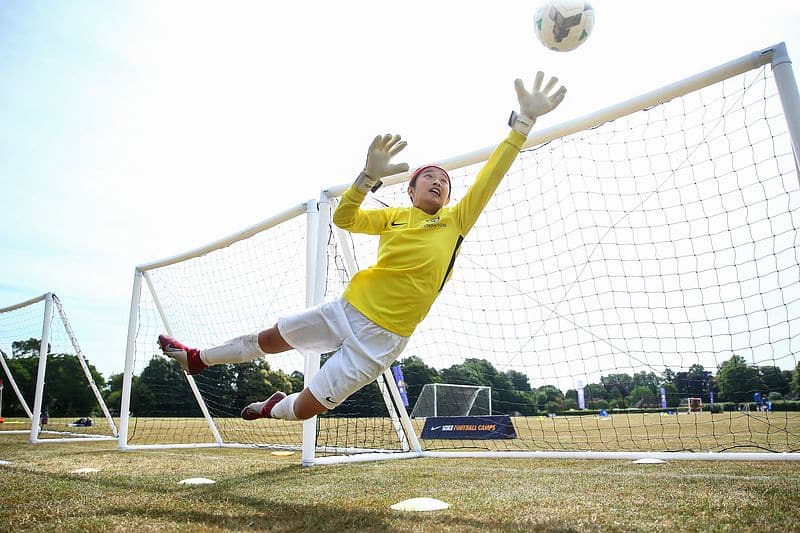
Working through these techniques independently is a solid starting point. But mental preparation genuinely embeds under match-like conditions : real pressure, real mistakes, immediate feedback from a specialist. Without that environment, routines tend to hold in training and break down when it counts. There are several paths to accelerating that process: working with a mental performance coach, integrating the mental side at club level or attending a specialist football camp.
A specialist goalkeeping camp is the best way to cover the most ground in a short space of time. It allows you to work on mental techniques in an intensive setting, with coaches specialising in the position and professional facilities.
Looking For Soccer has selected goalkeeping football camps at partner clubs equipped with professional facilities. Each programme is assessed on the quality of coaching, the structure of the sessions and the actual progress made by the participating goalkeepers. Here’s what these camps deliver on the mental side specifically:
- Specialist coaches throughout. Whether the camp is 100% goalkeeper-focused or one that includes a specialist track, the coaches leading goalkeeper sessions understand the mental demands of the position, not just the technical ones.
- Professional training conditions. Working on the same pitches and with the same equipment as professional squads changes what a goalkeeper expects of themselves. That environmental shift has a measurable effect on concentration and commitment.
- Mental preparation built into every session. Real-time error management, resets between drills, activation routines before high-pressure blocks. Mental skills are developed in context, not in a classroom. An intensive camp creates the conditions that most club environments simply cannot replicate.
Mental Strength Starts in Training
Goalkeeper mental preparation is not reserved for professionals. The reset, controlled breathing, targeted visualisation, and consistent match routines are all techniques any goalkeeper can begin today, regardless of level.
For those who want to go further, a specialist goalkeeper football camp puts these skills into practice in a high-quality environment, with expert coaches and professional facilities.
Frequently Asked Questions
What age should a goalkeeper start mental training?
The foundations (controlled breathing, positive self-talk, error management) can be introduced from age 10 to 12, in simple and age-appropriate ways. Structured visualisation becomes most effective from 14 to 15. Full match routines typically come together between 16 and 18. The goalkeeper camps selected by Looking For Soccer use approaches adapted to each age group.
How long before you see results?
Early effects (less anxiety before matches, faster recovery after mistakes) typically appear after 3 to 4 weeks of consistent practice. Durable improvements in competitive performance take 2 to 3 months. Regularity matters far more than volume.
Can a goalkeeper work on mental training alone?
Yes, for the foundational techniques. For more significant challenges such as recovering from a traumatic error, a sustained loss of form, or severe match anxiety, support from a sports psychologist or mental performance specialist is advisable. The camps selected by Looking For Soccer also provide the environment where these techniques can be tested under genuine competitive pressure.
Does mental training replace technical work?
No. It complements it. For a structured technical development programme, see our goalkeeper training guide. The two reinforce each other directly.
What’s the difference between visualisation and mental imagery?
Visualisation focuses on the technical gesture: the dive, the punch, the catch, imagined in precise physical detail. Mental imagery adds the full match context : crowd noise, scoreline, emotional stakes. Used together, they are significantly more effective than either alone.
How does a goalkeeper camp support mental development?
The camps we selected create intensive training conditions under genuine pressure, with immediate feedback from specialist coaches. That is exactly the environment in which mental techniques stop being theoretical and start being automatic. Development that might take a full season at club level can happen within a week of intensive work.
Also Worth Reading :
- Heading Banned in Great Britain: Why This Measure Protects Young Footballers
- Ideal Daily Diet to Boost Your Football Performance
- Expert Tips to Avoid Mistakes and Progress Faster in Football
- Free Kick Technique: How to Score Like the Pros in Football
- What Are the Characteristics of a Leader in Football?