
How to improve your goalkeeping skills ?
Goalkeepers touch the ball 40+ times per game and make decisions that directly impact 30% of scoring opportunities. Yet most young goalkeepers train without specialist coaching or clear development pathways, practicing the same basic drills while progress feels slow.
Improving as a goalkeeper requires targeted training across five core skills: reflexes, positioning, diving technique, distribution, and communication. This guide breaks down what to focus on, provides training methods for solo and group sessions, and explains how intensive camp environments accelerate development.

What makes a great soccer goalkeeper?
A great soccer goalkeeper combines elite reflexes, tactical positioning, technical shot-stopping ability, confident distribution, and strong communication skills. Beyond physical attributes, top goalkeepers demonstratemental resilience, decision-making under pressure, andleadership presence that organizes the entire defensive unit.
While height and athleticism certainly help, they’re not the only factors that determine success. Many professional goalkeepers stand between 5’10” and 6’2″ (178-188cm), compensating for any height disadvantage through superior positioning, reading of the game, and technical precision. The modern goalkeeper must also be comfortable with the ball at their feet, capable of accurate distribution, and willing to act as an 11th field player during build-up phases.
The complete goalkeeper profile includes:
- Physical attributes: Quick reflexes, explosive agility, hand-eye coordination, core strength, and the endurance to maintain concentration for 90+ minutes. These traits enable rapid reactions to shots and powerful, controlled diving movements.
- Technical skills: Clean catching technique, confident parrying decisions, various diving mechanics (low/high/at feet), and multiple distribution methods (throwing, goal kicks, passing). Technical proficiency allows goalkeepers to execute saves consistently under match pressure.
- Tactical intelligence: Understanding angles and positioning, reading attacking patterns before they develop, knowing when to come off the line versus holding position, and organizing defensive shape during set pieces. Smart goalkeepers reduce shooting angles by 30-40% through proper positioning alone.
- Mental attributes: Concentration throughout matches even when rarely tested, confidence that rebounds after mistakes, communication clarity that cuts through match noise, and decision-making speed in high-pressure moments. The mental game separates good goalkeepers from elite ones.
- Leadership qualities: Constantly directing defenders, calling for crosses with authority, organizing the defensive line’s positioning, and maintaining team focus during difficult stretches. Vocal goalkeepers prevent defensive miscommunication that leads to 15-20% of conceded goals.
Now that we understand what defines elite goalkeeping, let’s break down the specific skills you need to develop and exactly how to train them.
The 5 core skills every soccer goalkeeper must develop
These five competencies form the foundation of goalkeeper excellence. They’re universal and taught in youth academies from Barcelona to Manchester, from Paris to New York. Each requires focused practice with proper technique, ideally under the guidance of specialist coaches who understand the biomechanics and tactical nuances of the position.
1. Reflexes and Shot-Stopping
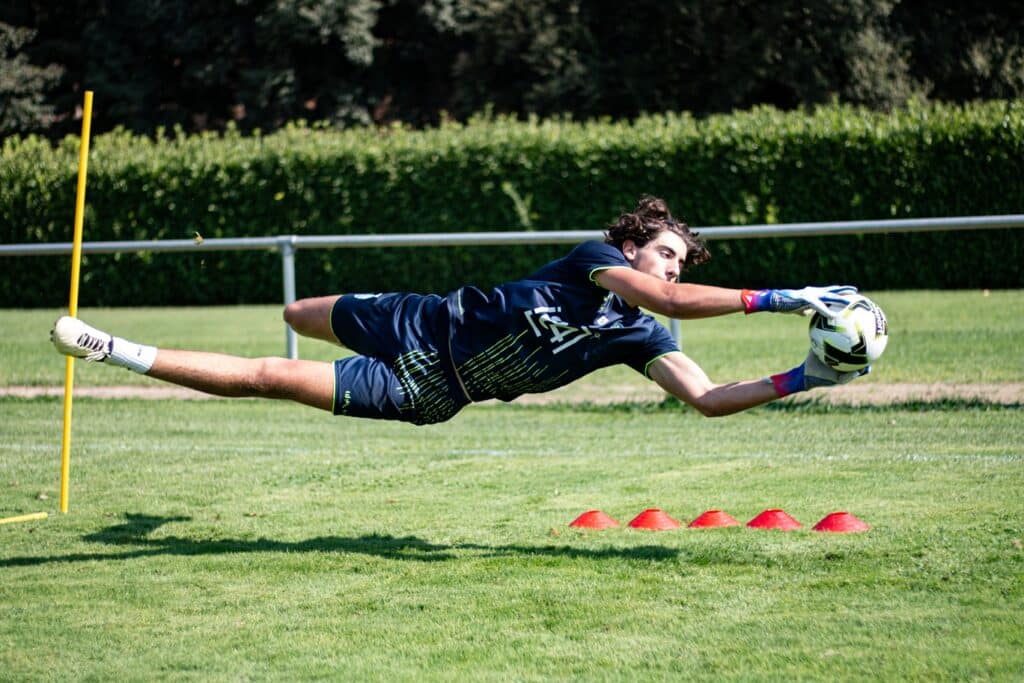
Goalkeeper reflexes improve through repetitive reaction drills, hand-eye coordination exercises, and game-situation training. Effective methods include rapid-fire shooting practice, reflex wall work, and close-range save scenarios that compress decision-making time.
Why reflexes are crucial ? When facing a shot from 18 yards, goalkeepers have approximately 0.2 to 0.4 seconds to read the shot trajectory and react. That split-second response determines whether the ball ends up in your gloves or the back of the net. Elite reflexes aren’t just about raw speed. They involve pattern recognition, anticipation based on striker body language, and muscle memory that triggers correct movements without conscious thought.
In order to train your reflexes effectively as a goalkeeper, here’s what you should do and know :
- Solo training methods include tennis ball wall work (throw against wall, catch 50 times in 2 minutes to build hand speed), reaction training apps that provide visual stimuli, and shadow saves where you practice explosive movements without a ball to build muscle memory for diving mechanics. For more solo training exercises, check out our complete guide.
- Partner-based drills deliver higher quality repetitions. Rapid-fire shooting, where a partner shoots 10 balls in 30 seconds from 12 yards, forces you to reset quickly between saves. Multi-ball drills, where balls come from different angles in quick succession, simulate match chaos and train your ability to refocus instantly after each save.
- Progressive training starts with distance and controlled pace, then adds speed and varied angles as technique solidifies. Early-stage goalkeepers need repetition with correct form. Advanced players benefit from unpredictability, such as shots from unexpected angles, deflections, and scenarios where they must adjust mid-dive.
Professional goalkeepers dedicate 4-5 sessions per week specifically to reflex training with specialist coaches who understand the biomechanics of explosive lateral movements. They use equipment like reaction lights, weighted medicine balls for hand strengthening, and video analysis to identify the microseconds where reaction time can be shaved.
The gap between club training and professional methodology is significant. Most youth club training provides 10-20 repetitions per session. Professional environments deliver 50-100+ repetitions daily, with immediate feedback on hand positioning, footwork, and body shape. This volume difference explains why intensive training camps can create dramatic improvements in short timeframes : they compress months of typical practice into days of focused, high-repetition work.
2. Positioning and Angles
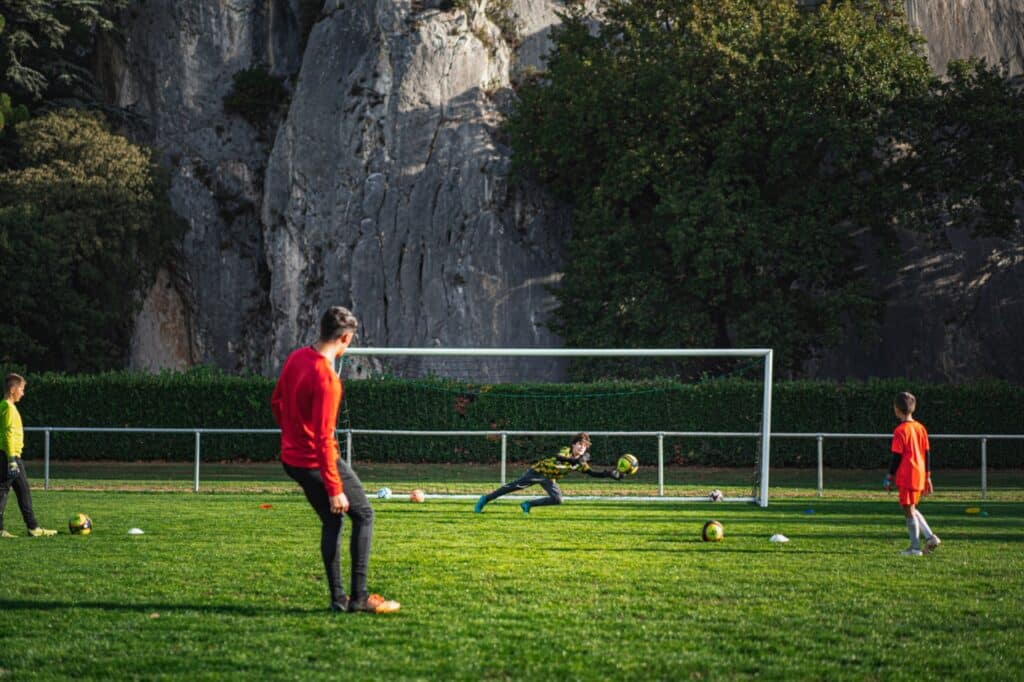
Proper goalkeeper positioning means staying on the optimal angle between the ball and goal center while maintaining the correct distance from the goal line. This geometric relationship reduces the shooter’s target area and maximizes save probability.
The geometry of goalkeeping: Every attacking position creates a theoretical triangle, with the ball at one point, and the two goal posts at the other points. Your optimal position sits on the arc that bisects this angle, positioned between the ball and the midpoint of the goal. Moving even one yard forward or sideways dramatically changes the shooting angles available to attackers.
A goalkeeper positioned two yards off their line reduces a striker’s target area by approximately 40% on shots from the penalty spot. Conversely, staying glued to the goal line gives attackers maximum space to shoot at. The challenge is reading how far to advance based on shot distance, shot angle, and the likelihood of through balls behind you.
Common positioning mistakes: During matches, you should avoid some common mistakes :
- Many young goalkeepers stay too deep on their line, effectively giving shooters a larger target.
- Others advance too aggressively, leaving space behind them for lobbed shots or through balls.
- Lateral positioning errors are equally problematic. If you’re not on the correct angle, even a modest shot can find the far post while you’re scrambling across.
Training proper positioning:
Cone drills help visualize correct angles. Set up cones representing various attacking positions around the penalty area. From each cone, identify where you should stand to bisect the angle. Have a coach or teammate verify your positioning, then practice moving between positions as the “ball” shifts.
Video analysis accelerates learning. Film yourself during practice or matches, then review positioning decisions. Were you too deep? Did you adjust quickly enough when the ball moved wide? Video reveals positioning patterns that are invisible in real-time.
Shadow training, like practicing movement patterns without a ball, builds muscle memory for proper positioning. Walk through defensive scenarios, constantly adjusting position as imaginary attacks develop. This mental rehearsal translates directly to match situations.
At high-level training environments, goalkeepers work with positioning coaches and video analysis tools that track movement patterns, measure distances from the goal line, and provide instant feedback on angle optimization. This level of detail is rarely available in weekly club training but standard at intensive training camps.
3. Diving Technique
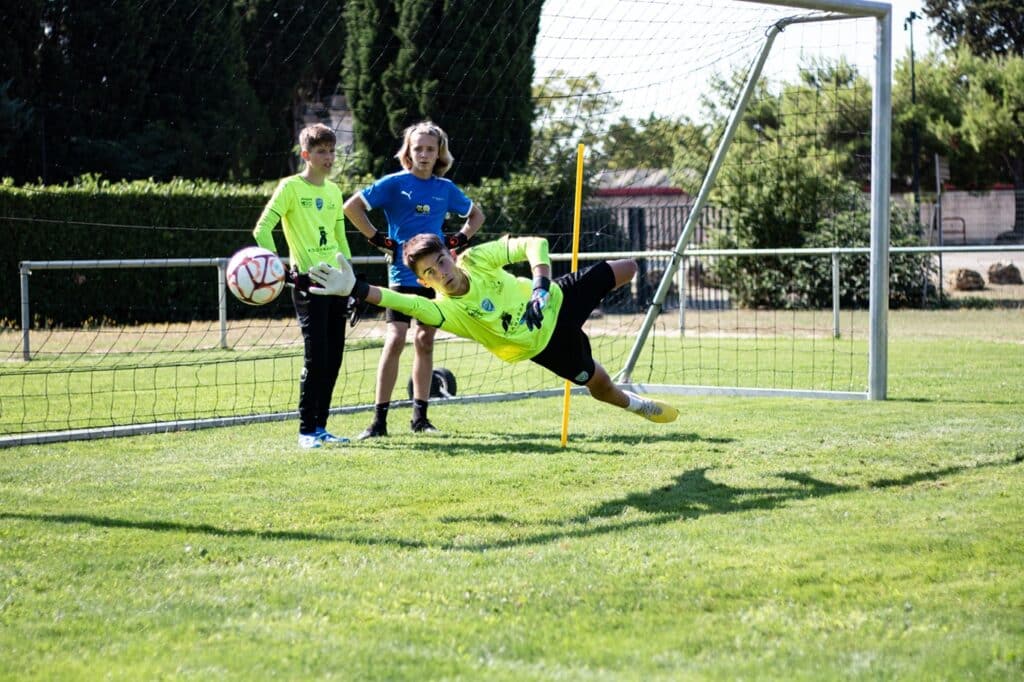
Correct diving technique involves explosive lateral movement, proper takeoff mechanics, and safe landing form. Key elements include pushing off the near leg, extending fully toward the ball, and landing on the side of the body to protect joints and maintain safety.
The mechanics of a perfect dive:
- Explosive push from near-side leg: Power comes from the leg closest to your diving direction. Plant hard and drive laterally, not backward. This generates the horizontal distance needed to reach shots.
- Full body extension toward ball: Stretch your entire body toward the ball path. Lead with your hands, keep your eyes on the ball, and extend fully, because half-committed dives rarely result in saves.
- Correct hand positioning: Your strong hand (the one closer to the ball) goes behind the ball to block it. Your weak hand comes over the top to secure it. This “sandwich” technique prevents the ball from slipping through.
- Safe landing sequence: Land on the side of your body, starting from the shoulder, then hip, then leg. Never land flat or on your stomach, which risks injury and makes it harder to recover for potential rebounds. Roll through the landing to distribute impact.
Learning progression:
Begin with collapse dives from kneeling position. Kneel on one knee, then tip sideways and practice landing correctly on your side. This isolates landing technique without the complexity of a full dive. The collapse dive drill, which consists of five sets of 10 dives per side, focusing purely on landing form before adding a ball, is foundational. Professional academies spend weeks on landing technique alone before progressing to full match-speed diving with shots. This patience with fundamentals prevents bad habits and reduces injury risk.
Progress to dives from standing position for low balls. Start close to the ball, focus on proper push-off and landing form. As technique improves, increase the distance you must cover.
Advance to full extension dives for high balls and shots to the corners. These require maximum explosive power, perfect timing, and confident commitment. They’re also the most spectacular and satisfying saves to make.
Finally, practice diving at striker’s feet in 1v1 situations. This requires courage, timing, and technique that makes your body as wide as possible while protecting yourself from contact.
Learning to dive correctly requires appropriate surfaces, such as grass fields or proper gym mats. Diving on hard ground or artificial turf without proper technique leads to injuries that can derail development. This is one reason why professional training facilities with quality surfaces and safety protocols matter significantly during skill acquisition phases.
4. Distribution and Footwork
Modern goalkeepers must be comfortable with their feet, capable of accurate throws (bowling, javelin, overarm), and able to execute various kicking techniques including goal kicks, clearances, and short passes under pressure. Distribution accuracy directly impacts a team’s ability to transition from defense to attack.
There are three types of distribution :
- Throwing techniques offer quick, accurate distribution over short-to-medium distances. The bowling technique (underarm roll) works for quick releases to nearby teammates. The javelin throw (baseball-style) reaches midfield targets with precision. The overarm throw generates maximum distance when you need to quickly hit a forward breaking into space.
- Kicking techniques vary based on distance and accuracy needs. Goal kicks from your hands or the ground must balance placement versus distance. Sometimes you need precision to hit your center midfielder, other times you need to reach the attacking third. Driven passes along the ground demand clean striking technique. Drop kicks from your hands can clear danger or launch counterattacks.
- Footwork under pressure separates modern goalkeepers from their predecessors. You must have a quality first touch when receiving back passes, composure to make decisions with defenders closing, and the technical ability to pass accurately with both feet. Mistakes here lead directly to goals conceded.
Training distribution skills:
Target practice for throwing: Set up 5-yard zones at various distances (10, 20, 30, 40 yards). Complete 20 consecutive throws into each zone, alternating between bowling, javelin, and overarm techniques. Track your accuracy percentage.
Passing circuits with teammates: Set up combination play scenarios where you receive a back pass and must distribute accurately under time pressure. Add a passive defender to increase difficulty.
Pressure scenarios: Practice receiving back passes and making distribution decisions within 2-3 seconds. This simulates match pressure and forces quick, confident decision-making.
Professional training camps often include field player coaches who work specifically on goalkeeper footwork, a crossover approach that bridges the gap between shot-stopping and modern distribution demands. This integrated training philosophy is less common in traditional club environments but increasingly necessary at competitive levels.
5. Communication and Leadership
Goalkeeper communication involves constantly directing defenders, calling for crosses, organizing the defensive line, and maintaining team focus. Effective goalkeepers communicate clearly, confidently, and continuously throughout the entire match.
It’s the only position on the field with a complete view of the entire game. The goalkeeper sees defenders out of position, attackers making runs behind the defense, and gaps in coverage that teammates can’t see while facing forward. Therefore, his voice prevents defensive breakdowns that lead to scoring opportunities.
There are 3 types of goalkeeper communication in soccer :
- Organizational commands direct defensive positioning: “Step up!” pushes the defensive line higher. “Drop!” tells defenders to retreat. “Mark number nine!” assigns defensive responsibilities. “Shift left!” adjusts defensive balance.
- Informational calls give teammates situational awareness they lack: “Man on!” warns a defender that pressure is coming. “Time!” tells a teammate they have space to control the ball. “Turn!” indicates they can face forward safely.
- Motivational communication maintains team morale and focus: “Great defending!” reinforces positive play. “Stay focused!” refocuses attention after a close call. “We’ve got this!” projects confidence during difficult moments.
How to develop confident communication :
Start by communicating constantly during training, not just matches. This builds habits and removes the awkwardness of finding your voice. Use simple, standard vocabulary that teammates immediately understand, as complex instructions get lost in match noise.
Speak loud, clear, and early. Anticipate situations and communicate before they develop, not during them. A defender who hears “Man on!” two seconds before pressure arrives can make a better decision than one who receives the call as they’re being tackled.
Practice taking authority. Many young goalkeepers hesitate to “boss around” older or more experienced teammates. Understand that your position demands leadership because defenders want and need your guidance.
Training communication effectively:
The silent training drill is powerful: Defend 5v3 attacking scenarios where only the goalkeeper can speak. This forces you to take complete leadership responsibility, constantly organizing defenders and providing information. It’s uncomfortable initially but builds communication confidence rapidly.
In high-level training environments like specialized camps, young goalkeepers practice communication in competitive scenarios with players they don’t know. This accelerates confidence development because you must assert leadership with unfamiliar teammates, a skill that transfers directly back to your club team.
How to train as a goalkeeper: solo vs. group sessions
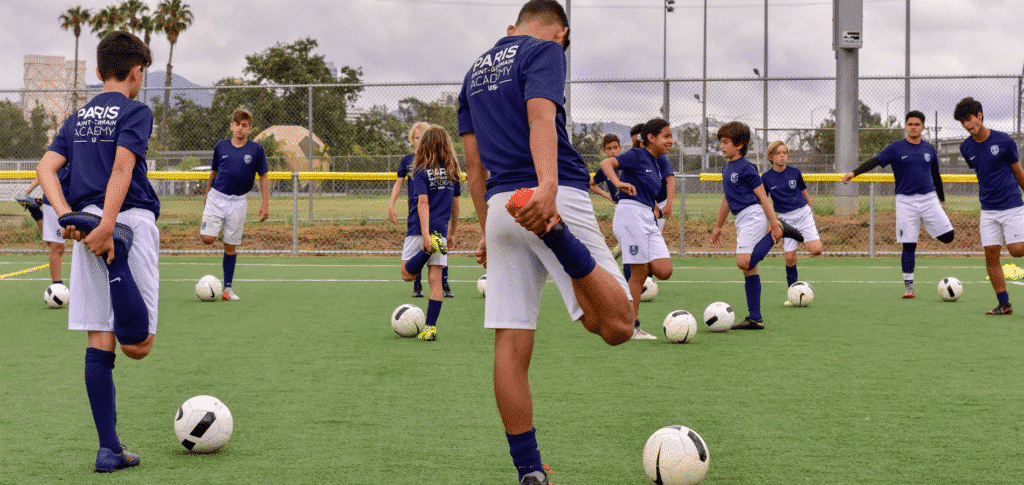
Solo training offers flexibility (train anytime, anywhere) and requires only basic equipment. However, you receive no external feedback and can’t simulate match pressure or complex scenarios like crosses and 1v1 situations.
If you choose solo training, it’s a good idea to film sessions to identify technique issues, vary exercises to avoid plateaus and set measurable goals to track your progress. Here’s a sample you could use to train at home :
- Monday: Reflex training (tennis ball wall work) + agility ladder
- Wednesday: Footwork + distribution practice (target accuracy)
- Friday: Diving technique on grass + flexibility routine
On the opposite, group training provides irreplaceable elements: realistic game situations, communication practice, immediate coach feedback, and competitive environment. However, most youth club teams have one goalkeeper coach for 3-6 goalkeepers, and meet 2-3 hours weekly. That’s only 20-30 minutes of individualized attention per goalkeeper per session. This training gap creates the opportunity for intensive training camps to deliver exponential value in compressed timeframes.
How to improve goalkeeper skills fast: the case for specialist camps
Consistent, well-structured training produces steady improvement over time. Becoming a competent goalkeeper takes 2-3 years of regular practice. Reaching competitive or elite levels requires 5-10 years of deliberate practice. There are no shortcuts to genuine mastery.
However, certain training environments create dramatic acceleration, “leaps” in development that compress months of typical progress into weeks. Specialized goalkeeper camps represent this kind of intensive environment, delivering 30-40 hours of focused training in a single week compared to the 2-3 hours per week most club training provides.
The Challenge for US Goalkeepers
Unlike field player development, specialized goalkeeper camps remain rare in the United States. Most American soccer camps offer limited goalkeeper-specific training, typically 1-2 hours mixed with general sessions over a week-long camp. The coaching is often provided by generalist soccer coaches who understand the game but lack the specific expertise in goalkeeper biomechanics, tactics, and psychology that drives elite development.
For serious young goalkeepers, this creates a significant development gap. While field players have abundant camp options across the country, goalkeepers seeking intensive, specialist training find limited opportunities domestically.
The European Advantage
Europe’s professional soccer infrastructure has spent decades developing goalkeeper-specific training methodologies. Clubs like Paris Saint-Germain, Atlético Madrid, Chelsea FC, and West Ham United employ specialist goalkeeper coaches with professional playing experience. Dedicated goalkeeper academies in France focus exclusively on the position, with comprehensive curricula covering technique, tactics, psychology, and physical conditioning.
For ambitious US goalkeepers, this isn’t a limitation : it’s an opportunity. Training at a European academy provides technical development under specialist coaches, international experience that broadens tactical understanding, exposure to different playing styles and training philosophies, and a competitive edge that distinguishes you in college recruiting and MLS academy evaluations.
College recruiters and MLS scouts value international training experience because it demonstrates commitment to development, exposure to high-level coaching, adaptability to different playing environments, and the maturity that comes from navigating international travel and cultural differences.
Why specialist camps deliver accelerated results ?
Training Volume and Intensity
A typical specialized goalkeeper camp delivers 4-6 hours of goalkeeper-specific training daily over 5-7 days. That’s 20-42 hours of intensive work in a single week, equivalent to 3-4 months of typical club training that meets 2 hours twice weekly.
The repetition volume is equally dramatic. Where club training might provide 10-20 repetitions of a specific technique per session, intensive camps deliver 50-100+ repetitions daily. This high-volume, high-quality repetition is how muscle memory develops and technical precision improves rapidly.
Multiple daily sessions target different skill areas. A typical day might include morning technical work (diving, handling, footwork), afternoon game situations (crosses, 1v1s, positioning), and late-afternoon competitive drills or fitness work. This varied approach prevents fatigue in any single area while comprehensively developing all aspects of goalkeeping.
Specialist Coaching Expertise
The coaching quality differential is substantial. Specialist goalkeeper coaches understand the biomechanics of diving, how to generate power from your legs, position your hands, and land safely. They recognize tactical positioning errors instantly and know exactly how to correct them. They understand the psychological aspects of the position, how to rebuild confidence after mistakes, maintain concentration during quiet matches, and develop leadership presence.
Many specialist coaches have professional or semi-professional playing experience. They’ve faced the situations you’re learning to handle. Their feedback comes from genuine expertise, not generalized soccer knowledge.
At European academies partnered with organizations like Looking For Soccer, coaches bring professional-level methodology to youth development. They’ve trained at clubs like PSG, Atlético Madrid, and other elite environments, and they know what separates good goalkeepers from elite ones.
Professional Facilities and Equipment
Quality training facilities matter significantly for goalkeeper development. Full-size goals with proper netting, quality playing surfaces that allow safe diving (well-maintained grass fields), specialized training equipment like rebounder walls, reaction training tools, and angle markers, video analysis systems to review technique, and access to conditioning facilities for goalkeeper-specific fitness work.
Professional training equipment like automated ball machines, reaction lights, and rebound walls cost $2,000-5,000 or more, investments that are inaccessible to most club programs but standard at professional academy facilities.
Competitive Training Environment
Training alongside goalkeepers of similar or higher ability creates healthy competition that drives effort and focus. You’re exposed to different techniques and approaches from players trained in other systems. The daily competition to perform well in front of specialist coaches pushes you harder than typical training.
This environment also normalizes the unique demands of the goalkeeper position. When you’re the only goalkeeper at your club, the position can feel isolating. Training in a group of specialist goalkeepers builds camaraderie and shared understanding.
Video Analysis and Technical Feedback
Professional camps film training sessions and provide video review with coaches. Frame-by-frame analysis reveals technical details invisible in real-time, such as hand positioning at the moment of contact, footwork in the split-second before diving, decision-making patterns across multiple scenarios.
What takes months to self-correct through trial and error becomes immediately visible and fixable with proper video analysis. You see exactly what you’re doing wrong, understand why it’s problematic, and receive specific correction strategies.
Immersive Learning Environment
Residential camps create total focus on goalkeeper development. You’re not balancing school, homework, and multiple activities You’re 100% dedicated to improving your craft for an entire week or two. This immersion accelerates learning because you’re constantly absorbing knowledge from coaches and peers, practicing techniques multiple times daily, and living and breathing the position.
The mental game develops significantly in immersive environments. You learn to handle pressure, maintain focus across long days, recover mentally from mistakes, and develop the confidence that comes from intensive, successful training.
Why booking a goalkeeper soccer camp with Looking For Soccer is a good idea ?
Looking For Soccer offers access to 15+ specialized goalkeeper programs across Europe, ranging from elite professional academy environments to dedicated goalkeeper training centers. Programs accommodate players from ages 10-18, with appropriate grouping by age and ability level. Durations range from one-week intensive programs to two-week comprehensive experiences. Options include residential (full immersion) or day camp formats depending on location and preference.
Also, the soccer camps provide small group training with favorable goalkeeper-to-coach ratios, video analysis of technique and decision-making, international experience that enhances college recruiting profiles, and flexible options from one-week intensive camps to longer-term academy placements.
Ready to accelerate your goalkeeper development? Explore all our goalkeeper soccer camps around the world.
Choosing the right goalkeeper soccer camp
When evaluating camp options, prioritize these factors:
- Specialist goalkeeper coaches with position-specific expertise, not generalist soccer coaches teaching multiple positions. Ask about coaching credentials, playing backgrounds, and goalkeeper-specific training experience.
- Small goalkeeper-to-coach ratios ensure individual attention. Ideal ratios are 6:1 or better. Large groups (10+ goalkeepers per coach) dilute the individualized feedback that drives improvement.
- Quality facilities and equipment including full-size goals, proper playing surfaces for safe diving, and specialized training equipment. Visit camp websites to see facility photos and equipment lists.
- Age-appropriate grouping so you train with players of similar age and ability. Mixed-age groups are less effective because training needs vary significantly between 11-year-olds and 17-year-olds.
- Comprehensive curriculum covering technique (diving, handling, footwork), tactics (positioning, decision-making), mental game (confidence, concentration), and physical conditioning specific to goalkeepers.
- Video analysis included in the program, not as an expensive add-on. Video review is essential for technical development.
- Reputable organization with track record of quality programs, positive reviews from past participants, and transparent information about coaching staff and facilities.
Conclusion : The path to excellence
Developing elite goalkeeper skills requires dedication, proper training methodology, and access to quality coaching across the five core competencies: reflexes, positioning, diving, distribution, and communication. For young goalkeepers in the United States, the scarcity of specialist coaching creates both a challenge and an opportunity. While domestic options remain limited, European training environments offer world-class development through intensive programs at professional academies where high-volume repetition, specialist coaches, and competitive environments can accelerate months of progress into weeks.
Whether your kid trains primarily at their club, incorporates solo sessions, or pursues intensive camp experiences, the key is deliberate practice focused on fundamentals, and with the right training approach and access to quality coaching, significant improvement is achievable at every stage of development. Still have questions ? Please don’t hesitate to contact our team for personalized assistance.
Frequently Asked Questions
Can my child train as a goalkeeper at home by themselves?
Yes, your child can develop certain skills through solo training at home: reflexes (wall work with a tennis ball), agility and footwork (ladder drills, cone work), and basic handling practice. However, game-realistic skills require group training: positioning in live situations, communication with defenders, dealing with crosses, and decision-making under match pressure. The most effective approach combines regular solo work (3-4 times weekly, 20-30 minutes) for maintenance with group sessions (2-3 times weekly) for tactical development.
My kid is not tall but wants to be a goalkeeper. Is that a problem?
Height provides advantages (reach, presence), but it’s not essential for goalkeeper success. Many professional goalkeepers are 5’10” to 6’1″ (178-185cm), not exceptionally tall. More important factors include reflexes and reaction speed, positioning and angle management, decision-making ability, technical quality in diving and handling, and footwork skills. Shorter goalkeepers can compensate through superior agility and quickness, excellent positioning that makes the goal “smaller,” technical precision, and tactical intelligence. Focus on developing the skills your child can control rather than worrying about height they can’t change.
Should I send my child to a goalkeeper camp or just stick with club training?
Both have value and work best in combination. Club training provides regular practice throughout the season, integration with their team’s system, and consistent coaching relationships. Specialized goalkeeper camps offer intensive skill development in compressed timeframes, expert specialist coaching with position-specific expertise, and accelerated progress through high-volume repetition. The ideal approach combines year-round club training for consistency with 1-2 specialized goalkeeper camps annually (during summer or holiday breaks) for intensive skill development that translates back to club performance.
Q: What’s the difference between a regular soccer camp and a goalkeeper camp for my kid?
General soccer camps include some goalkeeper training (typically 1-2 hours among 20+ total training hours) with generalist coaches who teach multiple positions. Specialist goalkeeper camps dedicate 100% of training time (20-40+ hours) to goalkeeper-specific skills with expert coaches who only train goalkeepers. They use specialized equipment and facilities designed for goalkeeper development and follow comprehensive curricula covering technique, tactics, psychology, and conditioning. For serious goalkeeper development, specialist camps provide exponentially more value through focused, expert-led training.