Soccer Boarding Schools from 6th Grade : Here’s What You Need to Know
Is your child entering middle school and serious about combining soccer with their education? In the US, most ambitious young players go through club soccer, such as academy programs run by MLS clubs, ECNL clubs, or other competitive leagues. But there’s another route that’s much less known in America: full-time “soccer boarding school”, originally a French model, now also available in the US, Spain, England, where players train daily and study on an adapted academic schedule. Here’s how the two compare, and what each one actually means for your child. To find out if your child is a good fit for this type of program, our team will evaluate them free of charge.

How Youth Soccer Development Works in the U.S.
Two main pathways exist for a middle schooler serious about soccer in the U.S. :
The Club Academy Track (MLS NEXT, ECNL)
This is the primary development pathway in the U.S. Club academies are independent of the school system : players attend regular school while training with their club 4 to 6 sessions per week. The two main ecosystems are MLS NEXT (the most elite platform, affiliated with Major League Soccer) and ECNL (the leading platform for girls). Access is by invitation or tryout. Most MLS academies are free while other elite clubs charge $3,000–$15,000/year.
One important rule: Players registered to an MLS NEXT Homegrown Division club generally cannot play for their middle school or high school team simultaneously. The Academy Division (launched 2025–26) does allow it.
The Private Full-Time Soccer Boarding School
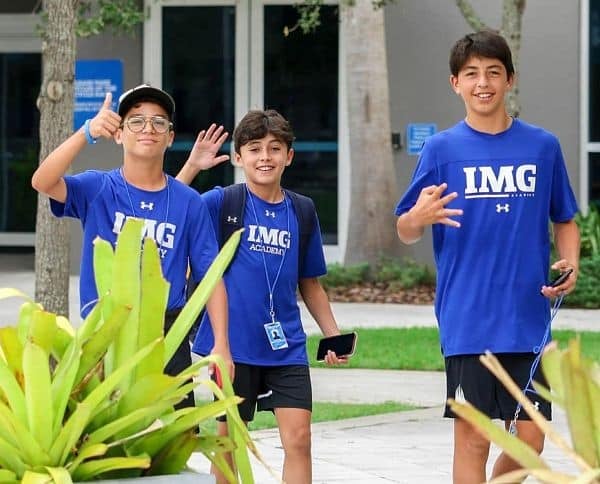
Beyond the U.S. club system, a growing number of families opt for immersive private academies, either stateside or abroad. These programs combine intensive daily training with an adapted academic schedule, often fully residential.
Where a U.S. club academy trains players 4–6 sessions per week while they attend regular school, Looking For Soccer partner academies in the US, France, Spain, and England offer 5 to 7 sessions per week (up to 8–12 in some Spanish academies) with a fully integrated academic timetable. The coaching staff are French soccer development professionals who have worked within the top formation centers and participated in the signing of many professional players.
Comparing the Two Pathways
| Criteria | U.S. Club Academy (MLS NEXT, ECNL) | Private Soccer Boarding School (Full-time) |
|---|---|---|
| Access | Invitation or tryout | Application + profile assessment |
| Cost | Free at MLS academies; $3,000–$15,000/yr at others | Tuition-based (several thousand dollars/year) |
| Training volume | 4 to 6 sessions/week | 5 to 7 sessions/week (up to 8–12 in Spain) |
| Academics | Regular school (public or private) | Partner school, adapted schedule, online or language courses |
| Coaching staff | Club-certified coaches | French soccer development professionals, former pro formation staff |
| Scouting exposure | Regional/national tournaments, ID days | Scouts invited on-site, organized trials, individualized follow-up |
| Destinations | United States | France, Spain, England, United States |
What Age to Start in a Soccer boarding school ?

In the U.S. club system, U13 is the standard entry point for elite academies. MLS NEXT clubs identify players through local league play, state cups, major tournaments, and open ID days.
For private international academies, programs start at age 11, both in the U.S. and abroad. Applications are often open until August for a September start, which gives families more flexibility than the French public system.
For players aged 15 and above, the NCAA university soccer pathway becomes a key horizon. A full-time private academy program, especially one abroad, can significantly strengthen a player’s profile for college recruitment. Learn more about soccer scholarships in the USA.
What gets evaluated when applying for a soccer boarding school from 6th grade ?
The teaching teams evaluate two aspects simultaneously:
- Football level. Academies look at the player’s current club level, competitive history, and assessments or feedback from current coaches. Some require a trial session or video submission as part of the application.
- Academic standing. Academic transcripts are reviewed to confirm the player can manage the workload of a full-time training schedule alongside schoolwork. A rough academic patch doesn’t automatically rule a player out. For many families, the structure and motivation that comes with a serious sporting project actually helps a student get back on track, and academies will often discuss this directly with families.
What Comes Next after a soccer boarding middle school ?
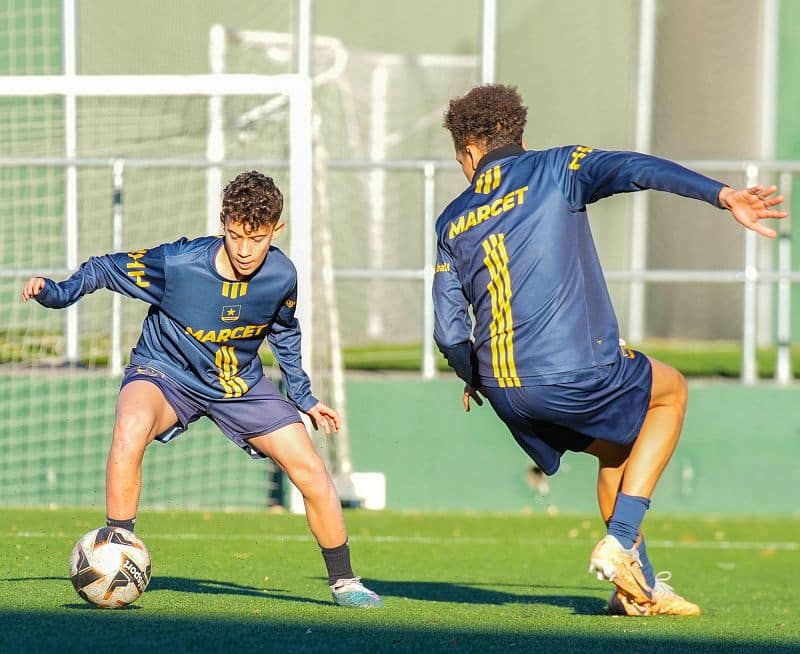
The middle school sports program offers several paths depending on the player’s profile and development:
- Continuing to a higher-level program: strong performers can move into more competitive tracks within the same network, including, the US and for players based at European locations, pathways tied to professional academy connections in France, Spain or England.
- Building a stronger recruiting profile for US college soccer or beyond: the structured, high-volume training environment and exposure to European coaching standards can meaningfully strengthen a player’s technical level and profile, which matters for college recruiting as much as for any professional pathway.
- Increasing visibility with scouts: Looking For Soccer’s partner academies are staffed by former professionals who’ve been directly involved in signing players to professional contracts in Europe, and who know how that recruiting process actually works. Trials and additional exposure are possible if a player shows real potential. Contact our team to explore available programs.
Not Sure Club Soccer Is Giving Your Child What They Need?
If your child has outgrown what their current club can offer or you simply want a more structured, intensive environment with a different level of coaching, a private soccer boarding school could be the answer. Looking For Soccer’s programs start at age 11, in the US and internationally. Our partner staff are former professionals from top European football development systems, bringing that experience and network to help every player progress toward their full potential. Request a free, no-obligation evaluation of your child’s profile.
Frequently Asked Questions on Soccer boarding schools for Middle Schoolers
Does my child need to be at a club to be considered for a private soccer boarding middle school ?
Not necessarily. Club experience helps demonstrate competitive level, but Looking For Soccer evaluates each player’s profile individually, including those who come from recreational backgrounds with strong potential.
Can my child join at any age, or is there a specific entry point?
Most programs accept players from age 11 with rolling admissions, unlike a single fixed yearly intake. Ages 13-15 are often considered a particularly strong window.
Can my child stay in the U.S. and still benefit from a structured program?
Yes. While most of our partner academies are based in Europe, there are structured co-ed programs in the U.S., where girls and boys train together in level-based groups. Contact our team and we’ll identify what’s available near you.
Is a soccer boarding school the same as a US club soccer academy (like an MLS Next academy)?
No. MLS Next and similar club academies are part-time programs layered on top of a normal school schedule. A soccer boarding school is a full-time program where daily training (5-7 sessions/week) and academics are integrated into a single schedule, often with options in Europe as well as in the US.
Will a soccer boarding school program hurt my child’s academic progress?
Not when run properly. These programs are built specifically so the academic track keeps pace with a normal curriculum. Many even show pass rates equal to or above standard benchmarks, because the discipline required by a serious daily training schedule tends to carry over into schoolwork.
My child’s current club isn’t taking them where they want to go. What now?
A private soccer boarding school is worth a serious look. It offers daily training in professional-level conditions with strong academic support, in the US or abroad. Talk to our team about which programs fit your child’s profile.
Read next: