
Soccer Camp: Immersion in a Professional World
Does your child constantly talk about Mbappé, Bellingham, or Haaland? Do they dream of knowing their routines, training like them, understanding what separates an amateur player from a professional? This legitimate aspiration drives thousands of families every year to search for a soccer camp that goes beyond the simple weekly training at their local club.
But here’s the thing: between marketing promises and reality on the ground, the gap can be considerable. Some camps proudly display “professional immersion” while offering little more than a holiday camp with soccer balls. Others, genuinely connected to recognized professional clubs, truly offer a glimpse behind the scenes of elite soccer – infrastructure, coaching, methodology, everything is there.
Having supported hundreds of families in their camp choices since 2019 at Looking For Soccer, we’ve observed closely what really happens behind the doors of training centers. This article reveals exactly what awaits your child in a genuine professional camp, how these programs differ radically from standard camps, and most importantly, how to identify those that deliver on their promises. You’re about to discover aspects that brochures never mention.

What Truly Distinguishes a Pro Camp from a Standard Camp
The difference isn’t just about logos on jerseys. It starts from the moment they wake up and permeates every minute of the day.
Facilities that change everything
Let’s take a concrete example. In a standard camp, your child probably trains on a shared municipal field, with decent locker rooms and functional equipment. Nothing wrong with that – it does the job. Now, imagine them arriving at a professional training center: fields maintained by dedicated groundskeepers who measure grass density daily, individual air-conditioned locker rooms with ergonomic seating, gyms equipped like sports clinics, temperature-controlled recovery pools.
This difference isn’t superficial luxury. It profoundly changes the learning experience. On a professional-quality field, the ball rolls differently – your child develops a finer touch because the bounces are predictable. In professional locker rooms, they unconsciously absorb the standards of organization and hygiene expected at the highest level. These details forge a mentality.
The figures speak for themselves: a top-flight training center invests an average of $2.5 to $4 million annually solely on facility maintenance. This budget often exceeds the entire budget of an amateur club. For one week, your child benefits from what normally costs a fortune in daily upkeep.
The coaching that makes all the difference
The real divide is at the human level. In genuine pro camps, the coaches aren’t friendly sports science students doing a summer job. They’re UEFA A or Pro licensed educators who dedicate their entire lives to developing soccer players. Some have guided players all the way to international level. Their eye for technical detail, their ability to correct posture in real time, their understanding of development pathways – none of this compares to standard coaching.
And that’s not all. Professional clubs have multidisciplinary teams: fitness coaches specializing in adolescent development, nutritionists who adapt menus to each young player’s profile, sports psychologists trained in performance issues. Your child doesn’t just access a coach, but a complete ecosystem designed for excellence.
A revealing anecdote: during a camp at Manchester City last summer, a 14-year-old boy complained of knee pain. Within 30 minutes, he was examined by the center’s physical therapist, who detected early inflammation of the patellar tendon. The staff immediately adapted his training program for the following days, probably preventing a serious injury. At a standard camp? They would have told him to rest and apply ice.
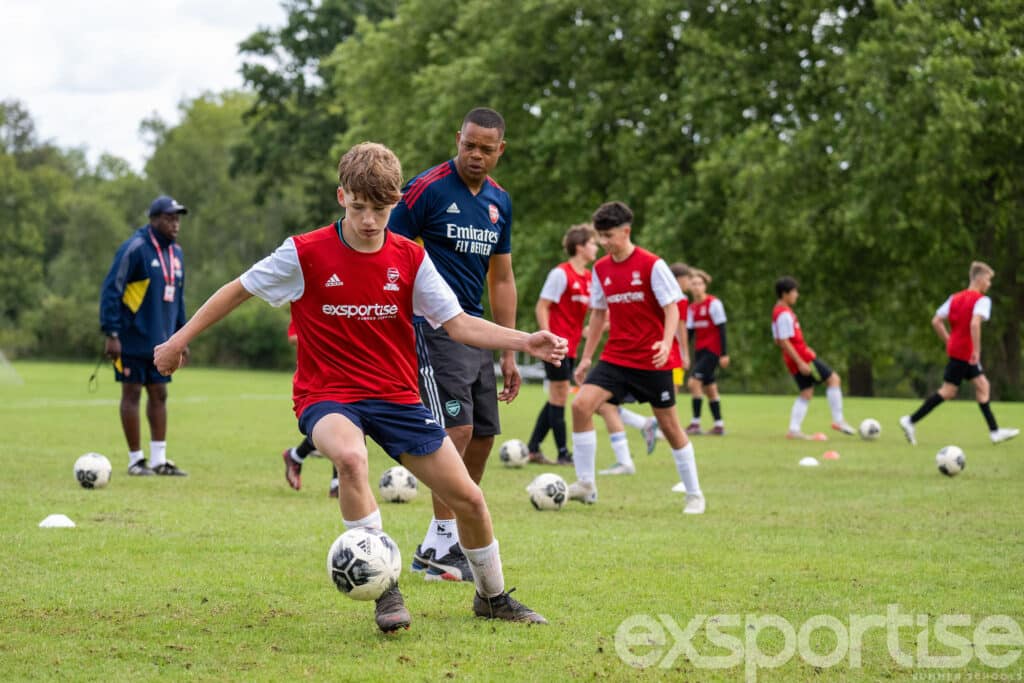
Discover the Arsenal soccer camps
Behind the Scenes of a Week in Professional Immersion
Forget the image of a camp where children arrive at 9am, kick a ball around until noon, have lunch, resume at 2pm and go home at 5pm. Professional immersion works differently.
The rhythm that forges champions
The day often starts around 7:30am with a carefully planned breakfast: carbohydrate/protein ratios calculated according to the planned intensity, controlled hydration. No greasy pastries or sugary cereals – we’re talking oatmeal, eggs, fresh fruit, yogurt. Some children find it restrictive for the first few days. Then they notice they have fewer energy crashes during training.
The morning session (9am-11:30am) focuses on pure technique: ball control, passing under pressure, first touch, shooting. The intensity remains measured because muscles are still cold despite the warm-up. Coaches constantly correct – position of the plant foot, body angle, timing of the movement. This individual attention, even in groups of 12-15 players, deeply impacts youngsters used to sessions of 20-25 at their club.
After lunch (again, nutritionally calibrated), there’s often a theoretical session. Tactical video analysis, breakdown of professional matches, understanding of playing systems. The children discover that professional soccer is also played with the brain. Some admit these moments completely change their view of the game.
The afternoon resumes with tactical work and themed scrimmages – specific situations repeated until they become automatic. Then active recovery: guided stretching, sometimes ice baths, breathing exercises. Finally, an individual debrief where each youngster receives personalized feedback on their day.
The invisible details that make the difference
What parents don’t see: coaches note everything in observation logbooks. Concentration ability, reaction to criticism, spontaneous leadership, frustration management after failure. These observations feed into the final report that some camps provide to families – a valuable document that truly guides your child’s future development.
Professional clubs also incorporate “behind the scenes” moments. Tours of administrative offices, meetings with scouts who explain their work, conversations with the equipment manager who details game-day logistics. These windows into the other side demystify the professional environment and provide a realistic view of soccer as a complete professional universe, not just a field and players.

How Professional Clubs Structure Their Camps
Not all professional clubs approach their camps the same way. Understanding their respective philosophies helps you choose the one that best suits your child.
The dominant models in Europe
English clubs (Arsenal, Manchester City, Liverpool) prioritize physical intensity and direct play. Their camps emphasize speed of execution, duels, the ability to play under high defensive pressure. Your child runs a lot, does sprint after sprint, learns to protect the ball against aggressive opponents. This approach particularly suits athletic youngsters who enjoy contact and high tempo.
Conversely, Spanish clubs (Barça, Real Madrid, Atlético) value possession, short passing, quick ball circulation. Fewer physical duels, more passes, off-the-ball movement, searching for space. Technically gifted but physically less imposing children often thrive better in these Iberian environments.
German clubs (Bayern, Dortmund) combine both schools: Germanic tactical rigor, quick transitions, coordinated pressing. Their camps are reputed to be particularly mentally demanding because they require discipline and constant collective understanding.
French programs, between tradition and modernity
Major French clubs have considerably evolved their camps in recent years. PSG, Lyon or AS Monaco now offer formats that blend French technical heritage (elegant play, individual creativity) with modern tactical input. Their camps systematically incorporate video work, GPS sessions to measure physical performance, and increasingly, content on mental preparation.
An interesting feature: some French clubs offer multilingual camps. Your child can follow training in French in the morning and English classes in the afternoon, combining sporting and linguistic development. This dual dimension appeals to many families seeking to make the most of the week beyond just soccer.
At Looking For Soccer, we’ve catalogued over 200 professional camps across Europe. Our observation shows that the most successful camps share three characteristics: coach-to-player ratio never exceeding 1:12, dedicated facilities (not shared with other activities), and above all, permanent staff rather than seasonal temporary hires.
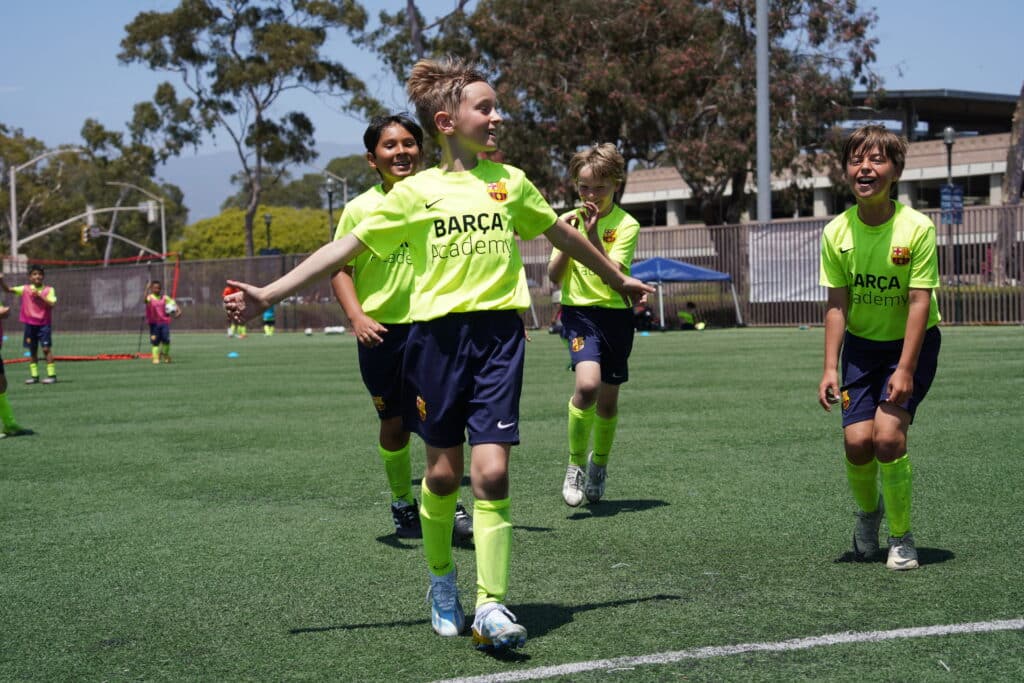
Discover the FC Barcelona camps
The Real Long-Term Benefits for Your Child
Beyond the magical week, what does your child actually bring home in their luggage?
A permanent elevation in technical level
Contrary to popular belief, an intensive week doesn’t miraculously transform an average player into a future pro. But it can trigger lasting technical breakthroughs. When a UEFA Pro coach spends 20 minutes correcting your child’s shot – foot placement, hip movement, ball contact – and that action is repeated 200 times during the week, something sticks.
Statistics confirm this: according to a study of 500 young people who participated in professional camps, 73% still showed measurable technical improvements six months later, as noted by their club coaches. Parents regularly report that their child “doesn’t play the same anymore” upon return – better control, more accurate passes, superior reading of the game.
But beware: these improvements only occur if your child then applies what they’ve learned. The professional camp provides the keys; it’s up to the young player to continue polishing these new skills daily.
An often underestimated mental breakthrough
The psychological aspect sometimes surpasses the technical. Many children return with transformed confidence. They’ve survived a demanding week in a professional environment, kept up with the pace, received positive feedback from prestigious coaches. This powerful external validation fuels their motivation for months.
Conversely, some youngsters realize during the camp that the professional level demands an investment they don’t wish to make. This early awareness avoids years of future frustration and allows soccer to be repositioned as a passionate hobby rather than a career objective. This is also a benefit, even if it seems negative at first glance.
The network and opportunities that open up
Professional camps create lasting connections. Your child meets youngsters from across the US, sometimes from all over Europe, who share the same level and passion. These friendships regularly lead to exchanges, tournament invitations, even recommendations between clubs.
Some camps provide detailed reports that you can share with your child’s club. When a Manchester City coach writes that your 13-year-old son “shows interesting potential as a box-to-box midfielder with excellent peripheral vision,” believe us, his club coach reads that feedback with attention. We’ve seen several cases of youngsters spotted during these camps and subsequently contacted for tryouts.
Choosing the Right Pro Camp for Your Child’s Profile
Not all professional camps suit all children. Here’s how to refine your choice.
Honestly assess your child’s actual level
Crucial first step: look objectively at where your child stands. If they play at a competitive travel level, dominate their team and have been selected for state or regional teams, “elite” professional camps suit them. If they play at recreational level, regularly but without particularly shining, lean towards “development” professional camps that accept a wider range of levels.
Classic mistake: overestimating your child through parental pride. We regularly receive calls from disappointed parents because their son or daughter found themselves completely out of their depth in an intensive camp. The child comes away with a negative memory and loses confidence. Better to shine at an appropriate level than suffer at one too high.
Practical advice: speak frankly with your child’s club coach. Honestly ask them if a level X professional camp seems appropriate. Good coaches appreciate this approach and generally give informed opinions.
Consider emotional maturity
Technical level is only one criterion. Maturity matters just as much. Some 12-year-olds handle a week away from home in a demanding environment perfectly well. Others at 15 still need to return home each evening to recharge with family.
Residential camps offer maximum immersion but require real independence. Your child will need to manage their belongings, respect strict schedules, share accommodation with strangers, handle continuous pressure. If it’s their first residential sports experience, perhaps start with a more reassuring day camp.
Similarly, some children love intense competition and constant challenges. Others, equally technically talented, prefer more nurturing environments focused on enjoyment and personal progression. English clubs tend towards the first approach, French clubs towards the second. It’s up to you to know your child’s temperament.
Budget and return on investment
Let’s be transparent: a professional camp costs between $700 and $2,200 per week depending on destination, format and club prestige. It’s a considerable investment for many families. Before committing, ask yourself the real question: why am I doing this?
If your objective is to offer an unforgettable vacation to your soccer-mad child, perfect, invest. If you’re secretly hoping this camp will open doors to an academy, temper your expectations – statistics show that fewer than 2% of professional camp participants are subsequently integrated into elite development structures.
The best return on investment concerns children already highly committed (minimum 3-4 training sessions per week) seeking to break through a technical or mental barrier. For them, a professional camp can genuinely serve as an accelerator of progress.
What Parents Need to Know Before Enrolling Their Child
A few truths that camp organizers don’t proclaim on their websites.
Promises too good to be true
Beware of camps promising “guaranteed scouting” or “academy pathway”. No serious club can guarantee a tryout – scouts follow youth leagues all year round, not summer camps. If an organizer promises you near-certain integration, it’s misleading marketing.
Likewise, “training with the pros” rarely means what you imagine. At best, campers briefly meet a professional player who comes to sign autographs. They obviously don’t train with the first team preparing for the season. Deliberately vague wording aims to make you dream without actually lying – be vigilant.
Objective quality criteria
Ask precise questions before enrolling your child. What’s the exact coach-to-player ratio? Who are the coaches by name (verifiable on LinkedIn)? Are the facilities those of the training center or fields rented for the occasion? Does the camp provide a detailed individual report?
Also check recent, verifiable reviews. On our platform, we only publish dated, named testimonials. Sites displaying anonymous or undated testimonials can easily fabricate them. Look for YouTube videos of parents recounting their experience – the video format makes fake reviews harder to produce.
Finally, inquire about cancellation terms. The best organizers offer reasonable cancellation insurance. Those imposing draconian penalties already show they don’t put the customer first.
Preparation that maximizes chances of success
Don’t let your child arrive physically unprepared. If possible, in the three weeks before the camp, encourage them to run regularly, do jogging, series of sprints. A child who arrives already in good shape will benefit infinitely more from the training than one who shows up after a month on the couch.
Prepare them mentally too. Explain that coaches will be demanding, the level will be high, they might feel challenged at times. Managing expectations avoids disappointments and early drop-outs. Emphasize that the goal isn’t to be the best but to improve personally.
Equipment: check the list provided by the organizer and prepare generously. Several pairs of socks, shorts and training shirts. High-protection sunscreen, personal water bottle, small first aid kit. These practical details ensure your child’s comfort and therefore their concentration on soccer.
Professional camps represent much more than just an intensive week of soccer. They offer a unique window into the demanding world of elite level sport, with its exceptional facilities, elite coaching and working methods that forge champions. For a passionate young player, this experience can mark a decisive turning point in their soccer journey.
But not all professional camps are equal. Between those that truly deserve the label and those riding the wave of marketing fashion, the gap remains considerable. Your role as a parent is to separate promises from reality, to objectively assess whether your child has the technical and emotional maturity to benefit from these demanding programs, and to choose the club and format that truly match their profile.
The investment – financial and time-wise – is worth it when all parameters align. Your child will return having grown, technically improved, mentally strengthened, and with memories that will fuel their passion for a long time. Take time to choose well, ask the right questions, and offer them this immersion that could change their view of soccer.
