
Football Academy Options for Secondary School-Age Players in England
Is your child starting secondary school and serious about combining competitive football with their education? In England, the standard route for an ambitious young player is the club academy system in Premier League and EFL club academies, or grassroots academies feeding into them. But there’s another model that’s far less known in the UK: full-time football boarding schools, a concept that originated in France and is also available in England, Spain, the United States and France itself, where players train daily and study on a schedule built around football rather than around it. Here’s how the two compare, and what each one really means for your child. To find out whether your child is suited to this type of programme, our team will assess them free of charge.

How Youth Football Development Works in England
Two main pathways exist for a secondary school age player serious about football in England:
The Professional Club Academy System (EPPP)
This is the primary development pathway in England. Professional club academies, structured by the FA/Premier League’s Elite Player Performance Plan (EPPP), are rated from Category 1 (highest) to Category 4. They are entirely separate from the school curriculum. As a result, players attend regular school while training with their club. Access is by invitation only, via direct scouting. Most Premier League Category 1 academies begin identifying players from age nine.
From U12, registered academy players sign two-year contracts with their club. From U14, clubs can recruit nationally rather than being limited by proximity rules. Around 10,000 boys are currently registered across Premier League and Football League academies. These places are exceptionally competitive.
The Private Full-Time Football Boarding School

For players who have not been identified by a professional club, or who want a higher training volume and more individualised support, private full-time academies are a serious alternative. These are independent, fee-paying structures offering intensive training alongside a fully adapted academic timetable — often residential.
Where a grassroots club player typically trains 2–3 sessions per week while attending regular school, Looking For Soccer partner academies offer 5 to 7 sessions per week (up to 8–12 in some Spanish academies) with integrated academic support. The coaching staff are French football development professionals who have worked within the top formation centres and participated in the signing of many professional players.
Comparing the Two Pathways
| Criteria | Club Academy (EPPP system) | Private Soccer Boarding School (Full-time) |
|---|---|---|
| Access | Invitation only (direct scouting) | Application + profile assessment |
| Cost | Free at professional club academies | Fee-paying (several thousand pounds/year) |
| Training volume | Increases by phase: ~3–5 hrs/week at Foundation, more at YDP | 5 to 7 sessions/week (up to 8–12 in Spain) |
| Academics | Regular school (with club welfare support) | Partner school, adapted timetable, online or language courses |
| Coaching staff | Club-certified coaches, welfare officers | French football development professionals, former pro formation staff |
| Scouting exposure | Internal club pathway, inter-academy competitions | Scouts invited on-site, organised trials, individualised player follow-up |
| Destinations | England | France, Spain, England, United States |
What Age to Start in a Football boarding school ?

In the professional club academy system, most Premier League Category 1 academies begin identifying players from age nine (Foundation Phase). If your child has not been picked up by U11–U12, the grassroots route (local FA-affiliated club, county league, regional competitions) is the primary environment where professional club scouts look for talent.
For private international academies, programmes start at age 11 both in England and abroad. Applications are often open until August for a September start.
For players aged 14–16, joining a private full-time soccer boarding secondary school abroad can open doors that the domestic grassroots route alone may not. An international experience also significantly strengthens a player’s profile if they later pursue the NCAA university soccer pathway in the United States.
What gets evaluated when applying for a football boarding school from secondary school ?
- Football level. Academies look at the player’s current or recent club level, any academy history (including previous releases, which are not held against a player), and feedback from current or recent coaches. Some require a trial session or video submission.
- Academic standing. Academic reports are reviewed to confirm the player can manage a full-time training schedule alongside schoolwork. A difficult academic period doesn’t automatically rule a player out. For many families, the structure and motivation that comes with a serious sporting project genuinely helps a pupil get back on track, and this is often discussed directly during the application process.
What Comes Next after a football boarding middle school ?
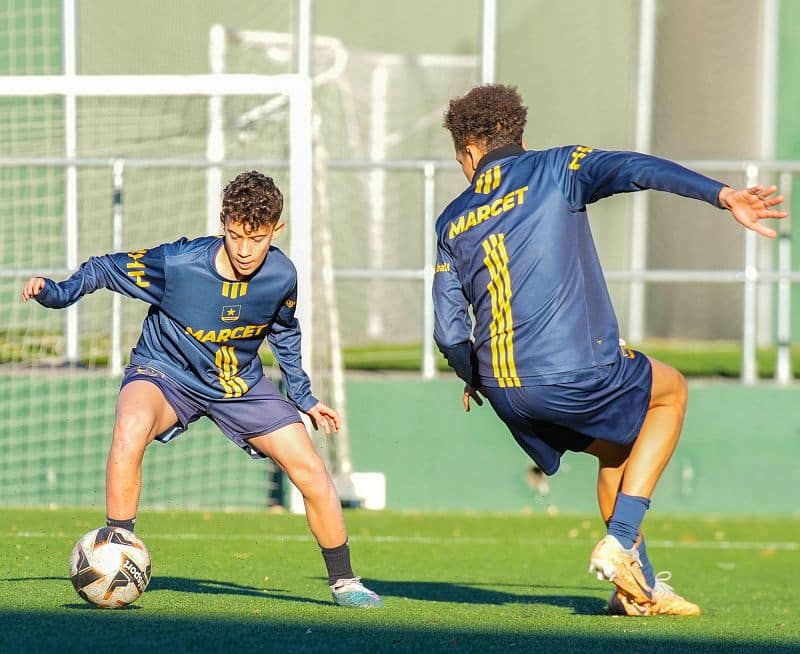
The school’s sports programme at secondary school opens up several paths depending on the player’s profile and development:
- On to a sports programme at sixth-form college: The natural progression. The Jean-Leroy Challenge (which brings together the 42 elite sixth-form college sports programmes accredited by the FFF) then becomes the goal for the most promising players.
- On to a private academy: For pupils seeking a daily training regime or wishing to move abroad. Looking For Soccer’s partner academies welcome many players from the state school system. Contact our team to find out about the programmes available.
- Towards a professional training centre: A sports section alone is not enough to trigger a talent scouting process. Training centres operate through immersion weeks, visits by scouts and on-pitch monitoring, regardless of the player’s school setting. They operate on the basis of direct scouting rather than unsolicited applications.
What Happens if the Club Academy System Isn’t Accessible?
Limited places, no local club opportunity, or a desire for a more immersive environment: not every talented player earns a place in the professional academy system. A private full-time football boarding secondary school is a strong alternative. It allows players to train daily in professional-grade conditions while maintaining quality academic support and building real exposure to international scouts.
Looking For Soccer supports families who want to give their child a serious development pathway outside the professional club structure. Our private academic programmes start at age 11, both in England and internationally. Request a free, no-obligation assessment of your child’s profile.
Frequently Asked Questions about Private Football programs in Secondary School
Is a private football boarding school the same as a Premier League club academy?
No. Club academies are part-time programmes run by professional clubs, with places decided through scouting and trials, layered on top of a normal school timetable. A private football boarding school is a full-time, fee-paying programme where daily training (5-7 sessions/week) and academics are built into a single schedule, with options in Europe as well as England.
Will a private football boarding school hurt my child’s academic progress?
Not when run properly. These programmes are designed specifically so the academic track keeps pace with a standard curriculum. Many show pass rates equal to or above national benchmarks, because the discipline required by a serious daily schedule tends to carry over into schoolwork.
Can my child join at any age, or is there a fixed entry point?
Most programmes accept players from age 11 with rolling admissions, rather than a single annual intake. Ages 13-15, often around the time of academy releases, are commonly considered a strong window.
My child was released from a club academy. Does that count against them for a private football boarding school ?
No. Academy releases are extremely common and aren’t held against a player. What matters is current level, motivation, and potential. Many private football boarding school players are former academy players looking to rebuild and progress further.
What’s the real difference between staying in the club academy system and joining a private football boarding school ?
The club academy system is free if your child is selected, and it’s the established route into English professional football. But places are scarce and outside that system, training quality varies hugely. A private football boarding school is fee-paying, integrates training and academics into one daily schedule, runs a much higher training volume (5-7 sessions/week), and, through Looking For Soccer’s network, connects players with former professionals who’ve been part of real professional signings in Europe. Trial opportunities and additional scout exposure are possible if a player shows genuine potential.
You might also enjoy