
What is futsal and how this indoor football game actually works ?
Futsal is an indoor football discipline played five-a-side on a hard court using a smaller, low-bounce ball, with rules officially standardized by FIFA. It is the sport that shaped Cristiano Ronaldo, Lionel Messi, Neymar, and Ronaldinho before they played professional eleven-a-side football. In England, the Football Association formally adopted futsal in 2014 and has since developed school and club programmes across the country. Looking For Soccer, the reference platform for booking football camps at elite clubs, explains what futsal is, how it works, and why it matters for player development.
What is futsal?
Futsal is an indoor football discipline played between two teams of five on a hard, flat surface with boundary lines. The word comes from the Spanish “fútbol de salón” and Portuguese “futebol de salão“, meaning “indoor football“. It was developed in Uruguay in the 1930s, spread through South America, and was officially recognized by FIFA in 1989. It is different from five-a-side football played in leisure centres and sports halls across the UK, which uses boards or walls and has no standardized rules. Futsal has specific court dimensions, a specific ball, and its own World Cup held every four years.
What is the difference between futsal and five-a-side?
Five-a-side in the UK is typically played in commercial leisure facilities with surrounding boards or walls, off which the ball can be played. There are no standardized national rules and formats vary widely between venues. Futsal is a FIFA-governed discipline with fixed rules, a specific court size, and a low-bounce ball that cannot be played off walls. Futsal is played out of bounds when the ball crosses the sideline, just as in outdoor football. The two activities are often confused but are fundamentally different games.
Futsal rules
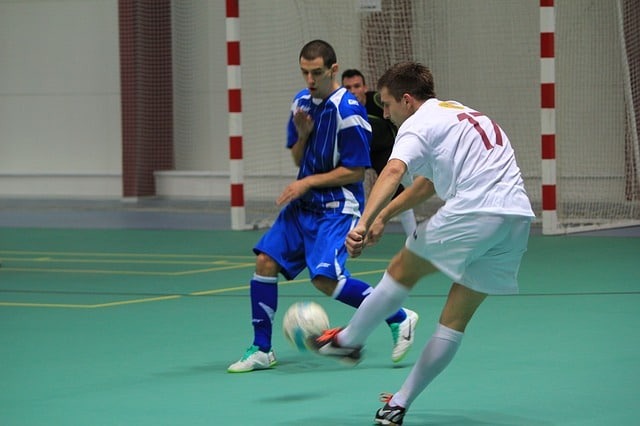
Teams and substitutions
Five players per team on the court, including the goalkeeper, with up to nine substitutes on the bench. Substitutions are unlimited and can be made at any point during the game. The incoming player must wait until the player leaving has fully exited the court through the designated substitution zone on the touchline.
How long is a futsal game?
Two 20-minute halves in stopped time, meaning the clock stops whenever the ball is not in play. Total match duration is typically between 60 and 90 minutes. In knockout matches, a 2 x 5-minute overtime in stopped time is played if the score is level after normal time, followed by a penalty shootout if required.
The five-foul rule
If a team accumulates five fouls in a single half, the opposing team is awarded a direct free kick from the second penalty spot, 10 metres from goal, with no defensive wall. This is a significant rule that changes how teams defend: tactical fouling becomes very costly, encouraging technical defending rather than physical intervention.
The four-second rule
Every restart, including kick-ins, goal clearances, corner kicks, and goalkeeper clearances, must be taken within four seconds. Failure to do so results in an indirect free kick to the opposing team. This rule keeps the game moving and eliminates time-wasting at dead balls.
Kick-ins instead of throw-ins
When the ball crosses a sideline, play restarts with a kick-in using the foot, not a throw-in. A goal cannot be scored directly from a kick-in.
The flying goalkeeper
A team may substitute their goalkeeper for an outfield player to play with six outfield players in an attacking situation. The incoming player must wear a different coloured bib and their own number.
Futsal court dimensions
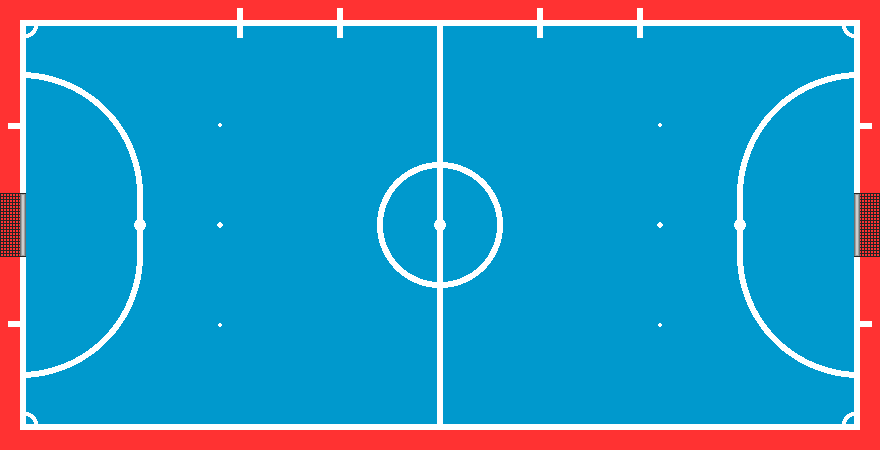
| Element | Official FIFA dimensions |
|---|---|
| Court size | 40 m x 20 m |
| Goal size | 3 m wide x 2 m high |
| Centre circle radius | 3 m |
| Penalty area radius | 6 m |
| First penalty spot | 6 m from goal |
| Second penalty spot | 10 m from goal |
The futsal ball

A futsal ball is size 4, smaller than the size 5 outdoor football, and has a low-bounce internal lining that reduces its rebound to roughly 55 to 65 per cent of the drop height. This is deliberate: the low bounce keeps the ball on the ground, forcing players to develop first touch, close control, and precise passing rather than relying on aerial play.
Futsal positions
The four positions in futsal are goalkeeper, defender (fixo), winger (ala), and pivot. The goalkeeper plays an active role in building from the back and rarely wears gloves, as foot play is as frequent as hand play. The fixo is the deepest outfield player, directing the team’s play and initiating attacks. The two wingers are the most technically skilled players, hugging the touchline and cutting inside to create movement. The pivot plays furthest forward, holding the ball under pressure and linking play with their back to goal.
Why does futsal develop better footballers ?

Futsal is recognized by the Football Association and sports scientists as one of the most effective technical development tools for young players. The smaller court and fewer players mean each participant touches the ball far more frequently per session than in eleven-a-side, accelerating the development of close control, first touch, and decision-making under pressure. The low-bounce ball demands precision on every touch.
The FA’s National Futsal Strategy identifies futsal as a core component of youth development, and several Premier League and Championship academies now incorporate futsal formally into their training calendars. Internationally, players like Cristiano Ronaldo, Messi, Neymar, and Ronaldinho all played futsal extensively before reaching professional football. To understand how the world’s best academies structure their technical development, read our guide on professional football academy training methods.
Futsal in England
The Football Association formally adopted futsal in 2014 and has since developed grassroots programmes, school competitions, and a national league structure. The National Futsal Series is the top tier of futsal in England. Several FA Charter Standard clubs now offer futsal alongside eleven-a-side football. The England national futsal team competes in UEFA Futsal Euro qualifiers.
Futsal is football at its most technical
Futsal is not a smaller version of football. It is football reduced to its most technical and tactical essentials, played at high speed in tight spaces with no room for error. The qualities it develops, close control, quick decision-making, positional awareness, are the same qualities that define the best outdoor footballers in the world. That is why the countries that produce the most technically gifted players, Brazil, Spain, Portugal, Argentina, all have deep futsal traditions.
Frequently Asked Questions about Futsal
What is the difference between futsal and five-a-side?
Five-a-side in the UK is played in commercial facilities with boards or walls, with no standardized rules. Futsal is a FIFA-governed discipline with specific court dimensions, a specific ball, and fixed rules. Futsal is played out of bounds when the ball crosses the line; five-a-side allows the ball to be played off the walls.
How long is a futsal match?
Two 20-minute halves in stopped time. Total match duration is typically between 60 and 90 minutes.
How many players are in a futsal team?
Five players on the court including the goalkeeper, with up to nine substitutes allowed.
Is futsal part of the FA structure in England?
Yes. The FA formally adopted futsal in 2014 and runs a national league structure (the National Futsal Series) alongside regional competitions and school programmes.
You might also enjoy: