

Your child hasn’t let go of their soccer ball since they learned to walk. They imitate Messi’s moves in the living room and dream of wearing their favorite club’s jersey. And you’re asking yourself THE question: are they ready for a soccer camp?
The short answer: most soccer camps accept children from age 6-7, but the ideal age depends primarily on your child’s maturity and independence. Some introduction programs exist from age 4-5, while intensive camps or overnight programs are better suited to children aged 8 and above.
According to US Youth Soccer, there are over 3 million registered youth players in the United States. And every year, thousands of families choose to send their children to elite soccer camps in Europe during school breaks. But how do you know if it’s the right time for yours?

Age Groups and Their Specific Characteristics
Not all children develop at the same pace. A 6-year-old might be perfectly comfortable in a group setting while their classmate of the same age might need another year or two. Here’s what you can expect according to your child’s age.
4-6 years: Introduction to soccer
At this age, we don’t really talk about “camps” but rather introduction sessions. Sessions are short, focused on motor skills and play. The goal? Discovering the joy of the beautiful game without pressure. Programs like Lil’ Kickers offer half-day camps for ages 3-5, with age-appropriate activities and fun zones. Check out our list of camps for children from age 6.
At this age, concentration rarely lasts beyond 45 minutes. A week-long intensive camp would be counterproductive. Save the European academy experience for when they’re a bit older.
6-8 years: The ideal time to start
This is generally the age range where the first “real” camps become relevant. Your child is beginning to understand group instructions, respect a team rhythm and manage their emotions on the field.
Day camps are particularly suited to this period. The child trains during the day and returns home to sleep at night. This formula reassures both parents and children who aren’t yet ready to spend a week away from their family.
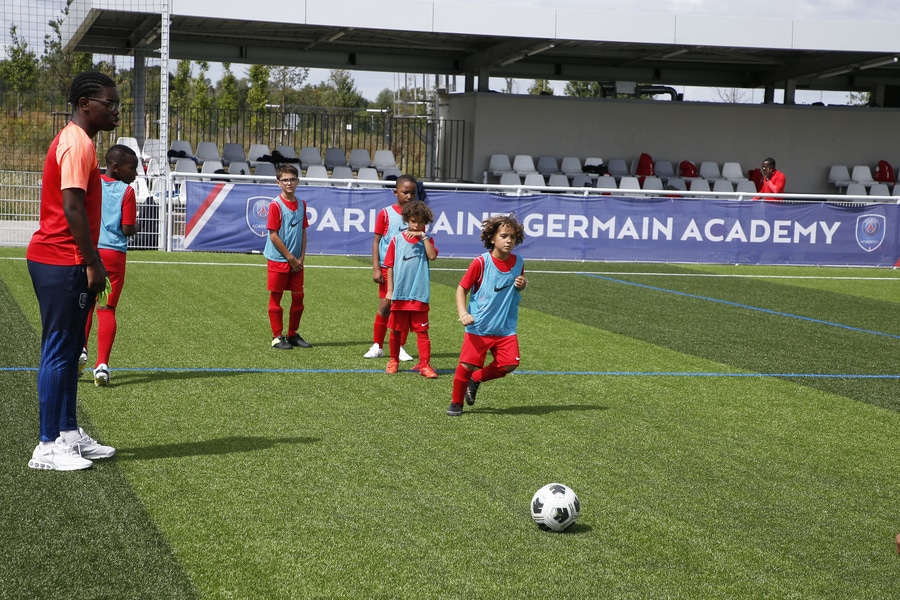
At 6-7 years old, your child can discover the basics of soccer with other children of the same age. Professional clubs like PSG Academy, Barcelona Academy and Manchester City offer specific programs for this age group, with enhanced supervision and age-appropriate drills.
8-12 years: The golden age for soccer camps
Between 8 and 12 years old, your child enters what coaches call “the golden age of motor learning.” Their coordination improves, they understand basic tactical concepts and can follow a more structured program.
This is also the age where overnight camps become viable. Sleeping away from home for a week, sharing a room with other young soccer players, managing their belongings… These experiences develop independence as much as soccer skills.
One parent shares on Trustpilot: “We had a great experience with Looking for Soccer. Our daughter enrolled in the PSG soccer camp in Paris. Information was provided timely. Any questions we had were answered immediately. The follow up communication was very reliable as well.”
13-17 years: Development and specialization
From age 13, camps take on a more intensive dimension. Teenagers can join elite programs, position-specific camps (particularly for goalkeepers) or camps combining soccer and language learning.
This is also the age when some young talents begin to be spotted by academies. As illustrated by João Félix’s journey, who joined FC Porto’s academy at just 8 years old before being transferred for $136 million to Atlético Madrid.

Criteria to Know if Your Child is Ready
Beyond chronological age, several indicators will help you determine if your child is ready for a soccer camp, especially one overseas.
Daily independence
Can your child dress themselves, manage their sports gear, follow instructions without constant reminders? For an overnight camp, these skills are essential. The staff are there to support, not to babysit.
A good indicator: how do they cope during school trips or sleepovers at grandparents’? If your child struggles with separation, a day camp will be more appropriate to start with.
Genuine motivation
The camp must be the child’s wish, not the parents’. A child who has been dreaming of training at Barcelona or Arsenal for months will have an extraordinary experience. A child “pushed” by their parents risks having a miserable week.
Ask them directly: why do you want to do this camp? What do you expect from it? The answers will shed light on their true motivation.
Ability to live in a group
A soccer camp is also a collective experience. Sharing locker rooms, accepting coaches’ instructions, managing the small frustrations of the game… Is your child ready for this social dimension?
Clubs impose age limits precisely to ensure group homogeneity. A 6-year-old in a group of 8-year-olds risks feeling out of place, even if they’re technically skilled.
Day Camp or Overnight: Which Format to Choose?
The choice of format depends as much on age as on your child’s temperament.
Day camps are perfectly suited to 6-9 year olds and children who have never attended a camp before. The child enjoys training during the day and returns to the family in the evening. It’s also the ideal formula if you’re vacationing near the camp location in Europe.
Overnight camps offer total immersion. Accommodation, meals, extracurricular activities: your child lives like a professional player for a week. This formula suits children aged 8 and above who already have some independence.
Another parent shares: “My son loved this soccer camp. Great fields and great coaches! Soccer at a high level. He also received a full evaluation at the end. One of the coaches used to play Pro for Brazil and also for PSG.”
The Soccer + Language Option: A Winning Combination
Many European camps now offer an option combining soccer and language classes. This formula allows your child to progress in two areas during their break.
Camps with English or Spanish tuition are particularly popular with American families sending their children to train at Premier League or La Liga academies. Children train in the morning with certified coaches, then follow language classes in the afternoon, or vice versa.
A satisfied parent shares: “Amazing experience! Quality supervision. My son discovered a new approach to training with the coaches. I recommend it to all young people who want to combine their passion with discovering new cultures.”
This option is particularly relevant from age 10-11, when the child already has some language foundations and can benefit from the classes.
Practical Tips for a Successful First Experience
Have you decided to take the plunge? Here are some tips to make this first experience memorable.
Prepare your child in advance. Explain how the week will unfold, show them photos of the venue, talk about the planned activities. The more they know what to expect, the calmer they’ll be—especially if it’s their first time traveling to Europe.
Respect the indicated age ranges. Do you think your 6-year-old can join a group for 7-year-olds because they’re “advanced”? Resist the temptation. Clubs set these limits to ensure group homogeneity and everyone’s enjoyment.
Choose the right level. Camps generally offer three levels: recreational (beginners), development (regular players) and elite/high performance. An overestimated child will have a difficult week. An underestimated child will be bored.
Provide appropriate equipment. Cleats, shin guards, change of clothes, water bottle… The equipment list provided by the organizer isn’t a suggestion, it’s a minimum.
Frequently Asked Questions
From what age can you enroll a child in a soccer camp?
Most soccer camps accept children from age 6-7. Some introduction programs exist from age 4-5, but they’re generally limited to a few hours per day. For overnight camps, the minimum age is often set at 8 or 9 years old.
Can my 6-year-old attend a camp designed for 7-year-olds?
It’s not advisable to bypass the age limits set by organizers. These ranges ensure group homogeneity, both physically and mentally. A child who’s too young risks feeling out of place and enjoying the experience less.
What’s the difference between day camp and overnight?
At a day camp, the child participates in training during the day and returns to their parents in the evening. At an overnight camp, they’re accommodated on-site with 24-hour supervision, meals and extracurricular activities. Overnight camps suit independent children aged 8 and above.
Do you need a good level to participate in a camp?
No. There are camps for all levels: recreational (beginners), development (regular players) and elite/high performance (club players at a good level). Each participant is placed in a group suited to their abilities.
What’s the average price of a soccer camp in Europe?
Prices vary according to formula and club. Expect from $500 for a week-long day camp, and from $700 for overnight. Camps at major European academies (Arsenal, Chelsea, Barcelona, PSG) can reach $2,500 or more for a week with accommodation and international travel coordination.
How do I prepare my child for their first camp overseas?
Explain how the week will unfold, show them photos or videos of the venue, talk about the planned activities. If it’s an overnight camp, have them stay a night or two with relatives to test their reaction to separation. Also discuss time zone differences and how you’ll stay in touch.
Are camps co-ed?
The vast majority of soccer camps are co-ed and welcome both girls and boys. Some organizers also offer girls-only camps for players who prefer this option.
Conclusion
The ideal age to enroll your child in a soccer camp doesn’t exist in absolute terms. What really matters is their maturity, enthusiasm and ability to have a group experience away from you.
Between 6 and 8 years old, favor day camps for a gentle first experience. From 8-9 years old, if your child is independent and motivated, an overnight camp will offer them total immersion in the world of professional soccer.
Still unsure? Our team is available 7 days a week at +33 7 57 94 26 36 to help you find the perfect camp for your child. With over 50 partner clubs in France and across Europe, we’re sure to have a program suited to their age and level.