
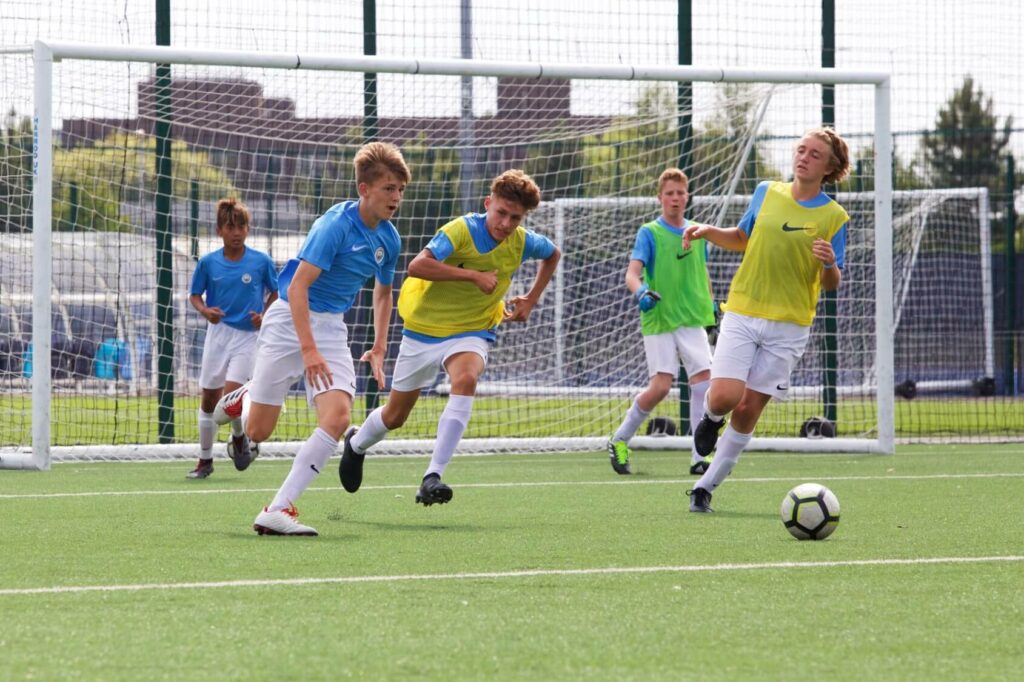
Every year, thousands of talented players go unnoticed. Not because they lack ability, but because they don’t understand how the scouting system actually works from the recruiter’s side. Talent identification in soccer follows precise logic, specific circuits, and evaluation criteria that go well beyond technical skill. Looking For Soccer, the reference platform for booking soccer camps at elite clubs, breaks it all down so that talent doesn’t stay invisible.

What is soccer scouting?
Soccer scouting is the process by which professional talent evaluators identify, assess, and track players with potential, with a view to integrating them into a club, academy, or development program. It’s not the same as an open tryout where any player can show up. Scouting is targeted: a scout will observe a specific player, often multiple times, before forming an opinion.
The distinction matters. An open tryout is an opportunity the player seizes. Scouting is a process the recruiter initiates, often without the player or their family knowing. Understanding this difference changes how you approach the whole subject.
In the United States, scouting operates through several parallel circuits: MLS Next and ECNL clubs, US Soccer Development Academy residuals, high school and club showcases, and increasingly the college recruiting pipeline through which coaches at NCAA programs identify prospects as young as 13 or 14. Understanding where these circuits intersect is more valuable than understanding any single one in isolation.
What do soccer scouts actually evaluate?
Technical ability: necessary but not sufficient
Technique is the entry ticket. A player who doesn’t control the fundamentals, like first touch, passing, ball control, won’t hold the attention of a serious scout. But technique alone doesn’t convince anyone. Academies and programs see hundreds of technically competent players every season. What distinguishes them is what lies beyond that baseline.
Physical and athletic qualities

Speed, power, coordination, and endurance are measurable criteria that scouts evaluate early. In the U13 to U15 age groups, athletic qualities are often the first filter. A player who is physically ahead of their age group draws attention. A technically brilliant but athletically limited player gets noted, but isn’t prioritized.
An important nuance: experienced scouts distinguish between a physical advantage linked to early maturity (which levels off over time) and genuine athletic potential. A tall U13 center-back who dominates through size alone won’t be evaluated the same way as a quick, well-coordinated U13 midfielder who is fast relative to peers of the same biological age.
Mental and behavioral profile
This is the criterion most underestimated by families, and one of the most decisive for scouts. Attitude in the locker room, reaction to a mistake, behavior toward teammates and referees, the ability to listen and apply coaching : all of this is observed and noted.
High-level academies invest in players they’ll be working with for multiple years. A player who is difficult to coach, loses confidence quickly, or disrupts the group represents a risk. A mentally strong, team-oriented player, even one with some technical gaps, is often preferred. In the US context, where the college recruitment process adds pressure from an early age, a player who handles high-stakes environments with composure stands out.
Development potential, not current level
Scouts don’t evaluate who is the best player on the field that day. They evaluate who will be the best player in three or five years. This potential-based logic changes everything. A player can be outperformed by a teammate today and represent a far more interesting profile for a scout if their development curve looks more promising.
The indicators scouts watch for: learning speed when corrections are made, the ability to transfer what’s worked on in training to match situations, and how the player behaves when their team is losing.
How does scouting actually work in practice?
Tournaments and competitive leagues: the primary pool
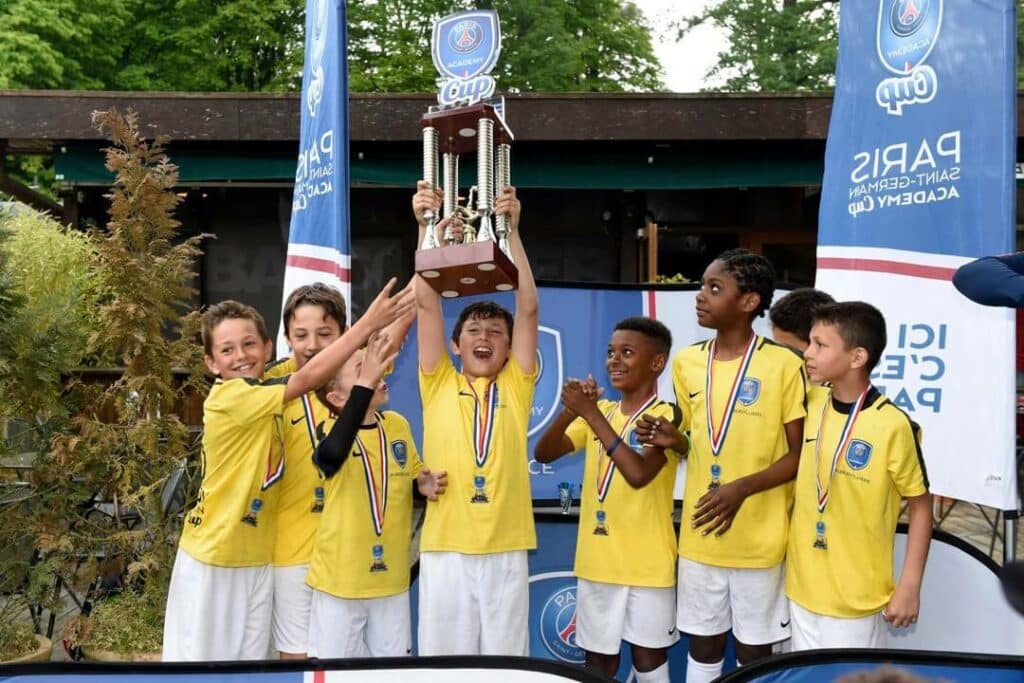
Most serious identification happens in competition, not in dedicated sessions. Scouts from clubs and academies cover regional and national championships, showcase tournaments, and youth competitions. They observe players in their natural environment, under real pressure, without the staging of an open tryout.
The direct consequence: the level of competition a child plays in largely determines their visibility. In the US, a player competing in an MLS Next or ECNL environment is systematically more exposed to scouts than a player dominating a lower-level recreational league. Playing up or seeking more competitive environments is one of the most concrete things a family can do.
Official tryout events
Open tryouts organized by clubs, academies, or regional federations remain an important circuit, especially for players who don’t yet have visibility in high-level competition. They allow a player to get in front of scouts who otherwise wouldn’t have had the chance to see them. But they don’t replace competitive visibility : they complement it.
Video scouting
Over the last decade, video scouting has transformed the work of talent evaluators. Platforms like Wyscout, InStat, and increasingly YouTube and Hudl allow scouts to evaluate players from anywhere in the world without traveling. For families, this means that having quality match footage is no longer a luxury : it’s a concrete visibility tool.
A well-edited highlight video, showing the player’s best actions, their positioning, decision-making, and game reading, can trigger the interest of a scout who would never have had the chance to see the player live. In the US college recruiting context, a strong video sent at the right time to the right program can open conversations that no showcase appearance would have started.
The network
The reality that few guides state clearly: network play a major role in soccer scouting. A coach who knows a scout, an educator who warmly recommends a player, a technical director who trusts a developer’s opinion : these informal connections open doors that performance alone doesn’t always open.
This isn’t a reason to be discouraged. It’s a reason to understand the importance of the environment: a good club, good coaches, a solid reputation built over time. All of it contributes to a player’s visibility.
What parents can do concretely
To help your child maximize their chances, here’s what you need to do:
- Choose the right competition level. Register your child in the most competitive environment accessible to their level, even if it’s less comfortable. Visibility against a higher level of play is more useful than being the best player in a weak league. In the US, moving from a recreational program to a competitive club environment, or from a lower-tier club to MLS Next or ECNL, is often the single most impactful step.
- Build a video portfolio. Film matches regularly, select the best actions, and have a shareable link ready. This isn’t marketing but a professional tool that families massively underuse, particularly in the US where college coaches specifically request highlight videos as a first step.
- Don’t apply pressure. Excessive parental pressure is one of the most common causes of poor performance at tryouts and showcases. Scouts also observe parent behavior on the sideline. This is documented, not anecdotal.
- Develop the mental profile. Encourage the child to take responsibility within their team, communicate with teammates, accept mistakes and corrections without shutting down or showing frustration. These behaviors are developed, not innate.
The role of soccer camps, soccer boarding schools and academies in the scouting circuit
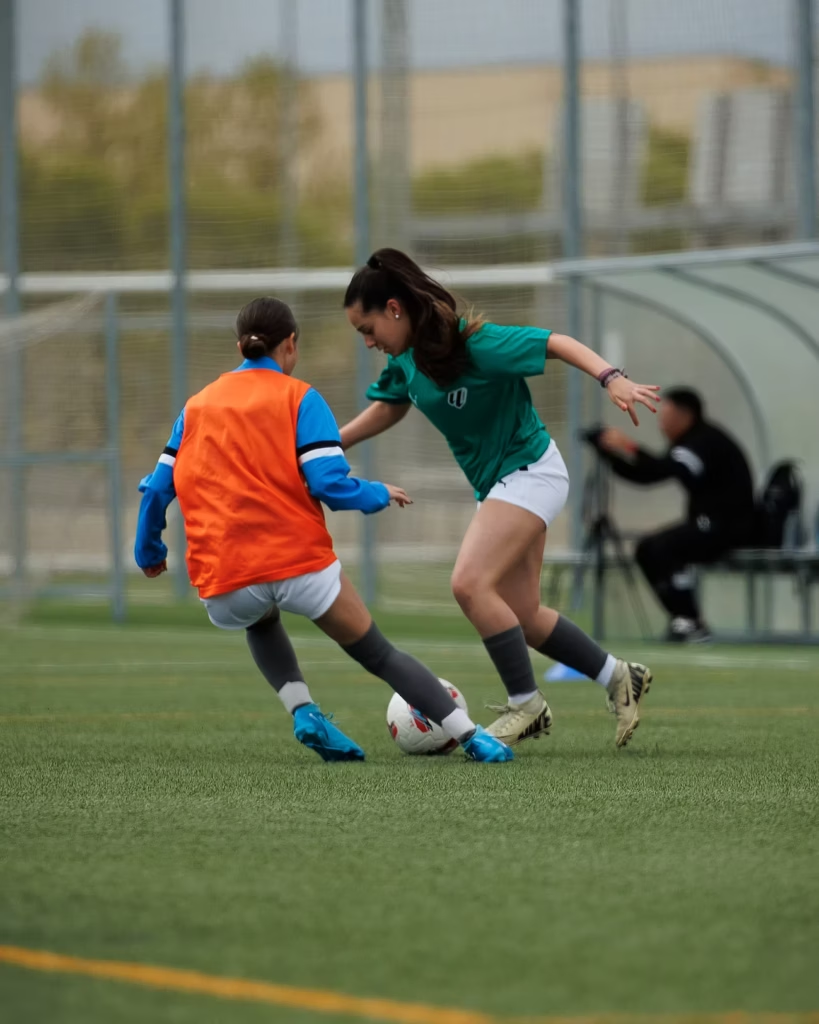
Camps at major academies are not primarily recruitment sessions. Their main role is player development. But some programs integrate a genuine evaluation component.
This is particularly the case for high-performance residential programs where the best participants from each session receive individual evaluations by certified club coaches. That feedback alone delivered by professionals from elite clubs is a development tool that most players never access through their regular club environment.
More broadly, spending a week in a high-level environment alongside players from around the world, in front of coaches certified by major clubs, creates a different kind of exposure than local competition provides. It guarantees nothing. But it creates conditions that the standard circuit doesn’t always offer.
For players who want to build their development over a full year, combining intensive training with structured schooling in a soccer boarding school is a serious alternative worth exploring. They don’t replace the scouting process, but they offer a framework that increases a player’s visibility: high training volume, regular competition, certified coaches, and in some cases direct exposure to scouts from partner clubs. If you’re interested in this format, our team is available to address any questions or concerns you may have. If you’re interested in this format, our team is available to address any questions or concerns you may have.
Frequently Asked Questions about Scouting and talent identification in soccer
At what age does serious scouting begin?
The first serious observations from professional clubs and major academies typically begin around ages 11 to 12 (U12-U13). Some highly structured clubs begin tracking profiles as early as U10, but formal commitments are rare before U13. The U14 to U16 years are often the most decisive for academy recruitment. In the US, college coaches are permitted to begin contact with prospects at certain ages under NCAA recruiting rules. Also, families should be aware of the specific timelines.
Does a player in a smaller market have the same chances as one near a major city?
Not automatically, but geography is less of a barrier than it used to be. Video scouting has reduced the proximity advantage significantly. A player with quality footage who competes in a strong league can attract attention from scouts far away. What remains unequal is the density of high-level tournaments and showcase events by region. Participating in national or multi-state showcases is the best way to compensate for geographic visibility gaps.
Can a soccer camp lead to a scouting opportunity?
Indirectly, yes. Camps at academies partnered with professional clubs expose the player to coaches trained by those clubs. If a player distinguishes themselves, the information can travel. That’s not the primary function of a camp, and no serious program promises recruitment. But high-performance programs do include formal evaluation of top participants, and that feedback has real value beyond any recruitment outcome.
Should families send video directly to clubs?
Sending an unsolicited video to a professional club has very little chance of leading anywhere. Recruiting departments receive hundreds of submissions and prioritize players they’ve already identified on the field. Video is more useful as a response tool. When a scout or college coach asks to know more about a player, having a clean, easily shareable edit makes a real difference. In the college recruiting context, proactively sending videos to coaches at programs that are a realistic fit is a standard and expected step.
Read next: