
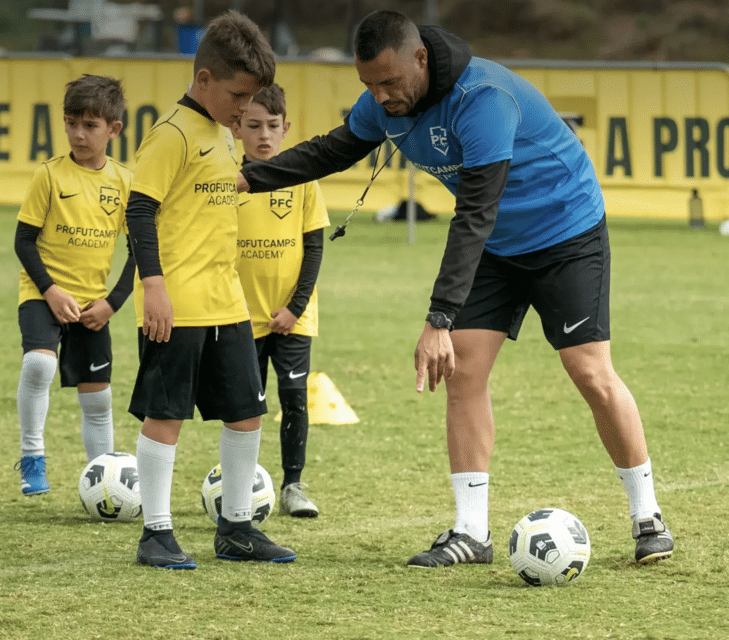
In November 2015, the US Soccer Federation officially banned heading for kids under the age of 11 in both practices and games. This decision made the United States a pioneer on the issue. Nearly a decade later, this rule continues to protect millions of young soccer players across the United States. But what does this policy really mean for your kid ? Should you be concerned? Looking For Soccer — the leading French platform for booking soccer camps in France and abroad — tells you everything you need to know about this regulation and what it means for teaching soccer to young kids.

Understanding US Soccer’s heading policy
In its US Soccer Concussion Initiative, the US Soccer Federation has been clear : no heading for U11 and younger age groups during practices and games. Otherwise, the referee must award an indirect free kick to the opposing team from the spot where the header occurred.
If the header occurs inside the goal area, the free kick must be taken on the goal area line parallel to the goal line, as close as possible to the place where the foul was committed.
Heading Guidelines for older age groups
While the ban is absolute for players under 11, US Soccer established clear guidelines for older youth players to ensure heading is introduced gradually and safely.
| Age group | Practice allowance | Game allowance | Key restrictions |
| 12-U and 13-U(11 to 13 years) | Limited practice only | No restrictions | 30 minutes max of heading sessions per week, with 15-20 headers per player per week |
| 14-U and older | No restrictions | No restrictions | Standard play allowed |
Source : The US Soccer Concussion Initiative by the US Soccer Federation
The Science Behind the Ban: Why Heading Poses Risks for Young Players
Taylor Twellman’s Story: A Wake-Up Call for American Soccer
In a 2013 interview, Taylor Twellman, former striker for the New England Revolution, revealed that he had suffered seven concussions during his career. It was the last one in particular that forced him to retire. On August 30, 2008, during a match against LA Galaxy, his head collided with goalkeeper Steve Cronin’s fist.
Unlike his previous concussions, the symptoms persisted and never went away. His testimony left a lasting impression: “You literally feel sick. No one can help you. There is no medication that can cure the concussions and brain damage I suffer from.”
Despite numerous attempts, Twellman was forced to end his career in 2010 at the age of 30. Fifteen years later, he still experiences post-concussion symptoms on a daily basis. For example, he admitted that he can no longer go to the movies or train in soccer.
Deeply affected by what happened to him, he created his foundation, ThinkTaylor.org, to raise awareness about head injuries among parents, coaches, and young soccer players. More than 4 million children have taken the ThinkTaylor pledge, committing to be informed, honest, and supportive when it comes to concussions. When US Soccer announced a ban on heading in 2015, Twellman tweeted, “I can’t tell you how moved I am that progress is being made.”
Now a soccer analyst for ESPN, Twellman remains a leading voice on player safety and continues to raise awareness about the risks that ended his career.
California Soccer Concussion Lawsuit Against FIFA and US Soccer
In August 2014, a group of parents and players filed a class-action lawsuit in California against FIFA and US Soccer. The suit targeted these organizations about how they were handling head injuries in soccer.
The plaintiffs said that soccer had a global problem with concussions, accusing them of being careless and negligent about safety. They needed new rules to protect players. For example, they proposed to limit headers for players under 17. In addition, they wanted temporary substitutions so injured players could be checked and new medical testing for past players.
At first, FIFA did not comment. It was only after several lawsuits that US Soccer relented and made the ban official. However, instead of 17 years old, the total ban applies to children under 11, with gradual authorization for older age groups.
How America Compares: International Heading Policies
The United States was actually a pioneer in protecting young players from heading-related injuries. Here’s how different countries approach this issue:
| Country | Age limit | Year implemented | Scope of ban |
| United States | 11 years old | 2015 | Practice & games (U10 and younger) |
| Scotland | 12 years old | 2020 | Practice only |
| England | 12 years old | 2022 | Games only |
| Belgium (Flandre) | 9 years old | 2024 | Practice & games |
| France | 10 years old | 2025 | Practice & games |
Many countries, including Spain, Italy, Germany, and most South American nations, have not yet implemented formal heading bans for youth players. The US continues to set the standard for youth player safety in this area.
Why Mastering Ground Skills First Makes Better Players
Did you know? The world’s best soccer players, from Lionel Messi to Kylian Mbappé, built their excellence on technical foundations from an early age. Ground play helps develop:
- Motor coordination: learning to control your body and the ball
- Individual technique: control, feints, dribbling, shooting
- Game vision: understanding space, movement, and team play
- Tactical intelligence: knowing when to pass, when to dribble, when to shoot
- Creativity: finding technical solutions to game situations
So don’t see the glass as half empty: this ban is an opportunity to strengthen your child’s technical development. Keep in mind that before the age of 10, there is little chance of opportunities for heading the ball. Later, when they are older, heading will come naturally.
How does LFS ensure your kid’s safety and development ?
At Looking For Soccer, we are committed to ensuring the safety and optimal development of every kid. Our soccer camps for the U6, U7, U8, U9, U10 and U11 age groups strictly adhere to all FFF regulations and go above and beyond in terms of coaching and quality.
Professional, qualified coaching
All our coaches are qualified and trained in the latest safety protocols. They are fully aware of the specific characteristics of each age group and adapt the sessions accordingly. The rules on heading are naturally integrated into our programs. This means that no kid will be frustrated and can concentrate on the most important aspects for their age group.
Focus on technical development
Our courses focus on learning the basics of ground play: directional control, short and long passes, ball control, dribbling, and shooting. Each session is designed to help kids progress in these essential fundamentals. Fun exercises allow kids to have fun while developing a real culture of ball skills.
Individualized monitoring and measured progress
Every kid develops at their own pace. Our coaches observe and support the progress of each young player, emphasizing their strengths and working on areas for improvement. The goal is not to make every kid perform well immediately, but to help them build a solid technical foundation that will serve them throughout their soccer career.
High-quality facilities and appropriate equipment
Our camps are held at recognized club facilities, with fields adapted to each age group. The balls used meet the recommended size and weight standards for young players. Every detail counts to ensure a safe and enjoyable experience.
An immersive and formative experience
Beyond the purely technical aspect, our camps offer a real experience of community life: respect for rules, team spirit, pushing oneself to excel, and managing emotions. These values are at least as important as technical skills and will accompany your kid well beyond the soccer field. Depending on the camp, excursions are organized to visit the city or iconic soccer venues (e.g., a visit to the Parc des Princes in France, etc.).
Discover our soccer camps for 6-U
Discover our soccer camps for 7-U
Discover our soccer camps for 8-U
Discover our soccer camps for 9-U
Discover our soccer camps for 10-U
Discover our soccer camps for 11-U
4 tips for parents of young soccer players
As a parent, you play a vital role in supporting your kid’s soccer career. The experts at Looking For Soccer gathered four tips to help you approach these new regulations with confidence:
Tip #1. Don’t panic: soccer remains a safe and beneficial sport
If you enjoy watching your kid head the ball, this ban may seem worrying. However, it is a positive step towards greater awareness. Soccer remains one of the most popular sports in the world, and its benefits for kids physical and mental health are well established. This measure aims to protect their health without taking away the fun of playing.
Tip #2. Trust certified coaches
All the courses we offer come from clubs that train their coaches to the new standards. As a result, they know how to adapt each training session, explain the rules to kids, and maintain high-quality learning. If you have any concerns or questions, our teams will be happy to discuss the matter with you by phone or via our contact form.
Tip #3. Praise your kid’s technical progress
After practice or a game, congratulate your kid on their ball control, successful passes, vision, or defensive efforts. By emphasizing these aspects, you help them understand that soccer is much more than just aerial duels. You also boost their motivation and self-confidence.
Tip #4. Talk openly about this rule
Explain to your kid why heading is prohibited before the age of 10: to protect their growing brain, just as we protect other parts of the body. Use simple, reassuring words. Tell them that they can learn this skill later, when their body is ready.
Conclusion
US Soccer’s heading ban for players under 11 represents one of the most important player safety advances in American youth sports history. Far from limiting the game, this policy protects young athletes during their most vulnerable developmental years while encouraging them to master the technical skills that create truly elite players.
Taylor Twellman’s sacrifice wasn’t in vain. His advocacy helped change youth soccer in America, ensuring that today’s young players can pursue their dreams without taking unnecessary risks. The heading ban has contributed to a measurable reduction in concussions while producing a generation of players with exceptional footwork and technical ability.
Soccer remains America’s fastest-growing youth sport for good reason: it builds fitness, teaches teamwork, develops mental toughness, and creates lifelong friendships. With proper safety measures in place, your kid can enjoy all these benefits while developing skills that will serve them whether they play recreationally or pursue college and professional opportunities.
At LFS, we’re proud to be part of this player safety movement. Our camps provide young American players with world-class coaching, international experiences, and a development pathway built on proper fundamentals and long-term health.
FAQ: Your questions about the ban on heading for kids under 11
- Can my 8-year-old still play soccer ?
Absolutely. The ban on heading applies to just one technical skill among dozens of others. Our camps are designed to help your kid practice the other fundamentals of soccer as normal: dribbling, passing, shooting, defending, moving around the field, and understanding team play.
- What happens if my kid heads the ball reflexively during a match ?
Whether it’s a reflex or unintentional, the referee must award an indirect free kick to the opposing team. Your kid will not receive a card or personal penalty. But it will help them understand that this technique is not yet appropriate for their age.
- Does this rule also apply to amateur clubs ?
All leagues and organizations may set their own standards, provided they meet the minimum requirements of the US Soccer Federation.
- At what age can my child start learning heading?
From the age of 12, your kid will gradually begin to learn heading, subject to certain conditions. Depending on their age, the length of dedicated sessions may be shortened (30 minutes max of heading sessions per week, with 15-20 headers per player per week). These sessions will help them gradually become familiar with heading under the supervision of certified coaches.
- Is heading dangerous for all ages?
No. With the right technique, appropriate supervision, and gradual learning, the risks of heading are greatly reduced for teenagers and adults. The main problem concerns younger kids, whose brains are still developing. It is the repetition of impacts, even slight ones, on an undeveloped brain that poses a problem. For adults with mature brains and good technique, heading can be practiced without major risk.