

What separates a Category 1 academy from a well-run grassroots club isn’t just the players or the pitches. It’s the method. Every session, every drill, every recovery protocol in a professional football academy responds to a precise objective, built on years of sports science research. Looking For Soccer, the reference platform for booking football camps at elite clubs, breaks down the 9 professional football academy training methods that shape players at the highest level, and how your child can experience them in a partner club programme.

1. Individual technical mastery
The foundation of every professional academy programme. First touch, short and long passing, ball control, finishing: these movements are repeated thousands of times until they become entirely automatic. At Marcet Academy in Barcelona, the MATRIX evaluation system tracks more than 50 individual technical parameters for each player, identifying precisely what needs work and adjusting each session accordingly.
The underlying principle: a player who doesn’t have to think about controlling the ball can focus all their attention on reading the game. This is the core of the Marcet Method: See, Understand, Decide, Execute. In the English academy context, where EPPP guidelines set minimum training hours but leave methodology to each club, this specificity of individual tracking is what distinguishes the best Category 1 academies.
2. Tactical awareness and game reading

Tactical development is what separates professional academy training from most grassroots environments. Players learn to read the game in real time, understand collective patterns, and anticipate the movements of teammates and opponents before the ball arrives.
At PSG Academy Pro, tactical sessions combine live game situations with structured collective debriefs. The goal isn’t players who follow instructions: it’s players who understand why they’re executing them. In the English system, where the EPPP emphasises game understanding as a core outcome from U9 upwards, this matters directly to how the best football academies in the world measure their own success.
3. Physical conditioning and fitness
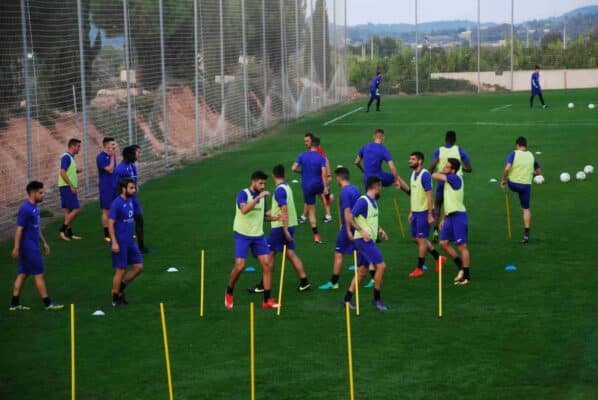
A competitive 90-minute football match at professional level demands exceptional physical conditioning. Professional academies run individualised programmes built around explosive strength, speed, aerobic endurance, and resilience to physical challenge. These programmes are tailored by position and age group, with loads designed specifically for developing bodies.
GPS sensors worn during training measure distance covered, sprint counts, accelerations, and peak speed in real time. This data allows coaches to manage training load precisely, preventing overtraining and reducing injury risk. EPPP Category 1 standards require this level of sports science infrastructure as a condition of licence, which is one reason why the best football academies in England operate at a fundamentally different level to grassroots clubs.
4. Mental preparation and discipline
Professional academies have understood for years what sports science confirms: elite performance is as much mental as it is physical. Managing pre-match nerves, recovering from an error without losing focus, sustaining concentration across a full 90 minutes, and maintaining daily discipline across a demanding season are skills that are developed through structured work.
At PSG Academy Pro, sports psychologists integrate visualisation, emotional regulation, and concentration techniques directly into the daily programme. For English players who have experienced the EPPP system, where release rates approach 90% before 18, the mental resilience to bounce back from setbacks is as important as any technical quality. Read more on mental preparation in football.
5. Video analysis
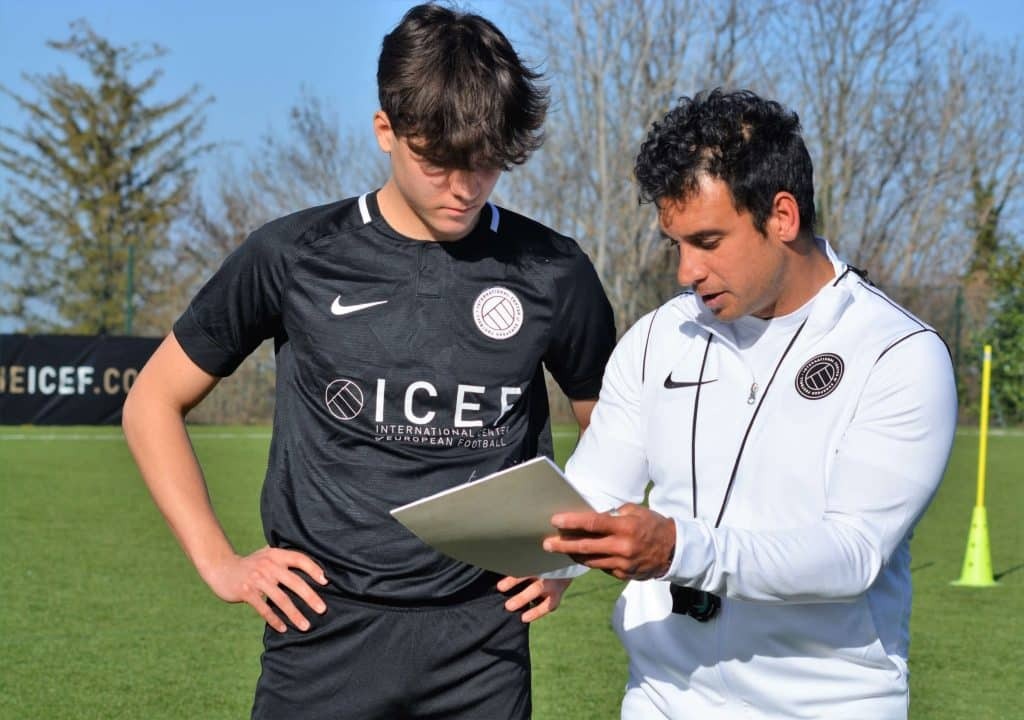
Every training session and match is recorded, then reviewed with coaching staff to identify errors, development margins, and collective patterns to reinforce. Players learn to watch themselves play, recognise their own tendencies, and understand their own decision-making in game situations.
Platforms like Wyscout and Hudl allow coaches to tag precise sequences and project them during individual or collective debriefs. At Marcet Academy, individual weekly video sessions let each player track their own progression on specific indicators linked directly to their personalised development plan. This analytical feedback loop is standard at Category 1 level and largely absent from grassroots football.
6. Match simulation and competitive pressure
Simulated matches and high-intensity game situations are central to every professional academy programme. These sessions bridge the gap between training exercises and competitive football: result pressure, stress management, quick decision-making, and on-pitch communication under conditions that replicate a real game as closely as possible.
At PSG Academy Pro in Évian-les-Bains, the strongest players from each session receive individual evaluations from club-certified coaches. This exposure, within an international group competing at a demanding level, is a development environment that a weekly club session simply cannot replicate. For players released from an English academy, this kind of structured exposure can be a genuinely formative next step. Our guide on how to get scouted in football explains how this visibility works in practice.
7. Nutrition and recovery
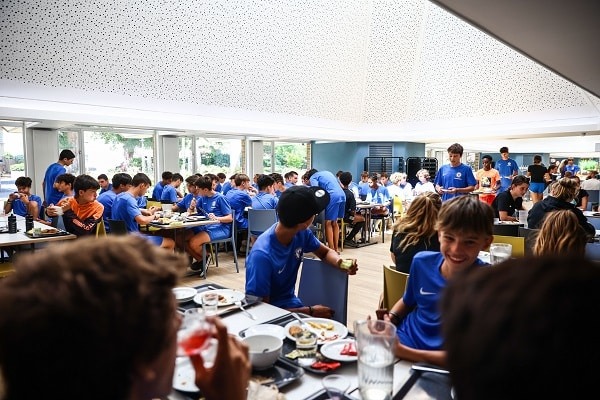
Elite academies treat nutrition and recovery as performance components, not optional extras. Nutritionists design meal plans around training loads: carbohydrate loading before sessions, protein after effort, monitored hydration throughout the day. Sleep protocols, stretching, recovery pools, and medical monitoring are built into the daily schedule alongside the training itself.
In residential programmes offered through Looking For Soccer, meals are prepared directly by the club, overseen by professional nutritionists. For British families, this structured nutritional environment is one of the most tangible practical differences from what a player experiences at home. Our guide on young footballer nutrition covers the essential principles.
8. Technology as a performance indicator
GPS sensors built into training bibs measure real-time distance, top speed, acceleration counts, and pitch coverage. Heart rate monitors track cardiovascular load across each session. Biomechanical analysis systems complete the picture at the most advanced academies.
All this data feeds into individual dashboards that allow coaches to adjust training load in real time, flag overtraining risk before it becomes injury, and personalise every development programme. At Marcet Academy, the MATRIX system integrates more than 50 individual parameters from these technologies to build each player’s plan. EPPP Category 1 clubs operate at this same level of technological integration as a baseline requirement, not a differentiator.
9. Holistic player development
The defining feature of elite academy training is the holistic approach to player development. Technique, tactics, physicality, and mentality are not treated as separate compartments but as interconnected dimensions of a complete profile.
This integrated approach is particularly clear in the Atlético Madrid methodology, exported to Palencia Football Academy: high physical intensity, aggressive pressing, fast transitions, and a competitor’s mindset form a coherent system that builds complete players. In English football, the tension between technical development and physical conditioning has been a long-standing debate. The best academies resolve it not by choosing between the two, but by building programmes where both reinforce each other.
How can your child experience these techniques during a football camp?

These 9 methods are not reserved for players under contract with professional academies. The camps offered by Looking For Soccer at partner clubs including PSG Academy Pro, Atlético Madrid, and Marcet Academy give your child the opportunity to experience these methods directly, coached by certified professionals alongside players from around the world. For families considering a more structured year-round programme, such as a football boarding school programme, our article on balancing football and studies provides a useful complement to this guide.
9 techniques, one goal: complete players
Professional academy training doesn’t aim to produce players who master movements. It aims to develop players who understand football in its full complexity, who adapt under pressure, and who keep progressing season after season. These 9 methods, combined within a coherent programme run by professionals, are what creates that sustained development. If you would like to book a camp so that your child can benefit from these techniques, our team is on hand to answer any questions you may have.
Frequently Asked Questions about Professional football academy training methods
How many hours a day do players train in a professional football academy?
At academy level, players typically train between 2 and 5 hours per day across technical, tactical, physical, and recovery sessions. EPPP Category 1 academies must provide a minimum of 10 coaching hours per week for U12-U16 players and 16 hours per week for U17-U21 players. Intensive residential programmes like Marcet Academy can reach over 35 hours per week across all disciplines.
What is the EPPP and how does it structure academy training in England?
The Elite Player Performance Plan, introduced in 2012, sets minimum standards for training hours, coaching qualifications, facilities, education provision, and sports science support at English professional academies. Category 1 academies must provide UEFA-licensed coaches, integrated schooling, and a full performance science and medical infrastructure.
At what age are these training techniques applicable?
Foundational techniques including individual technical mastery and basic tactical awareness are introduced from ages 6 to 8. More advanced components including structured video analysis and mental preparation are progressively introduced from around age 12.
What is the difference between an intensive camp and a recreational programme?
A recreational programme prioritises enjoyment and basic development. An intensive or high-performance programme includes individual evaluation sessions, higher training volumes, and expectations close to those placed on contracted academy players. See our selection of best intensive football camps 2026.
You might also enjoy: