

50% of all English academy players leave the system before the age of 16. Research published in Frontiers in Sports and Active Living puts it plainly: of the 1.5 million boys who play organised youth football in England, only around 180 will be signed professionally by a Premier League club. That is a success rate of 0.012%. The release, when it comes, is often devastating. Studies document depression, anxiety, and loss of identity in players as young as 14. But the story doesn’t have to end there. Spain has spent decades building the most concentrated ecosystem of elite youth football academies in the world and four of them partner with Looking For Soccer to offer a structured, intensive alternative for players who are ready to keep going.

Why Spain for a football boarding school?
A world-reference methodology
Spanish football is built on possession, individual technique, and tactical intelligence. Coaches, many of them UEFA Pro licensed, develop players who read the game and make fast decisions under pressure. The volume of training reflects this ambition: some academies in this selection run 8 to 12 sessions per week, compared with 3 to 4 in a standard English school sports programme. This density changes the pace of development in ways that are difficult to replicate. To understand how this rhythm sits alongside academics, read our article on life inside a football boarding school.
Year-round training conditions
With over 300 days of sunshine per year in some regions, Spain offers near-optimal conditions for development throughout the year. Mediterranean temperatures, outdoor natural grass pitches, and no winter disruptions mean more training, better recovery, and faster progression. For English players used to months of indoor sessions and waterlogged pitches, this is a meaningful structural advantage.
Professional infrastructure
FIFA-standard natural grass pitches, modern synthetic surfaces, weight rooms, swimming pools, video analysis suites, and medical centres: the Spanish academies in this selection operate facilities that rival professional clubs. This is the baseline, not the exceptional feature.
Cultural and linguistic immersion
Ten months in Spain builds genuine Spanish fluency, one of the most widely spoken languages in the world, alongside independence and an international perspective. For players who may later consider a football or academic path outside England, this broadens the horizon considerably. Read more about football university scholarships in the USA.
Comparison: 4 partner academies
| Academy | Location | Age | Training volume | Speciality | Fees (indicative) |
|---|---|---|---|---|---|
| Soccer Inter-Action | Valencia (Enguera) | 13–23 | 12h+/week + matches | Valencia CF partnership | £31,000/year |
| Marcet Academy | Barcelona | 11-21 | 35h+/week | Proprietary method, 45-year history | £38,000 – £51,000/year |
| ProFutCamps Academy | Marbella / Málaga | 11-23 | 2 sessions/day | Holistic approach, premium climate | £19,000 –£51,000/year |
| Palencia Football Academy | Palencia | 15–19 | Daily intensive | Atlético Madrid method, elite competition | £19,000/year |
Fees are indicative for a 10-month all-inclusive programme. Request a personalised quote from our team.
The 4 partner academies of Looking For Soccer in Spain
1. The Football boarding school program at Soccer Inter Action Academy in Valence
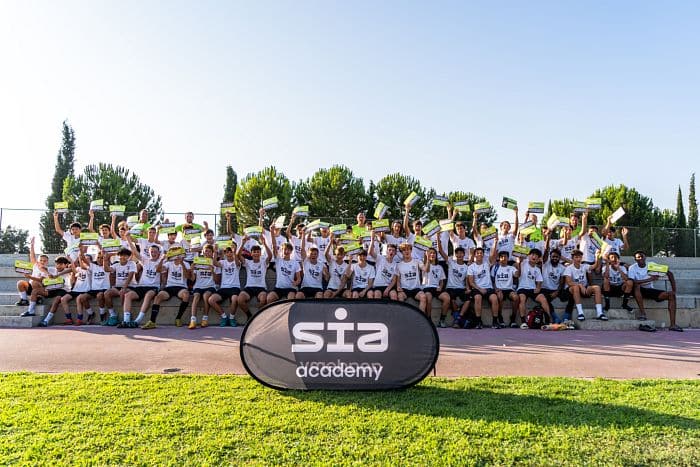
Valencia CF recruits players here. Your child could train where they were spotted.
Over the last five years, Soccer Inter-Action has been the single largest contributor of players to Valencia CF. This is not a branding partnership : it is a direct pipeline between the academy and a historic LaLiga club, with scouts who know the campus, the coaches, and the players by name.
The SIA campus runs full professional infrastructure: multiple FIFA-standard pitches (natural grass and synthetic), an Olympic pool, weight rooms, a medical centre, and state-of-the-art video analysis suites. An integrated British School on campus allows students to follow an international curriculum in English, which makes it a direct advantage for families considering a university football scholarship in the United States.
The methodology combines Valencian football principles (combination play, short passing, high pressing) with modern tactical periodisation. Each player receives an individualised development plan with GPS tracking, biomechanical analysis, and weekly video sessions. Teams compete in over 50 official matches per year, in Valencian leagues and international tournaments including MIC Barcelona and the Surf Cup. Players come from 35+ nationalities.
Programme details:
- 10-month programme, September to June
- Full-board residential on campus
- Boys and girls, ages 13 to 23
- Fees: £31,000/year, all-inclusive
- Location: SIA Center, Enguera (80 km from Valencia)
Discover Soccer Inter-Action Academy
2. The Football boarding school program at Marcet Academy in Barcelone

Barcelona produced Messi. Marcet produced players who almost played alongside him. Han Kwang-song signed with Juventus. Oliver Torres with Atlético Madrid. Konrad de la Fuente joined La Masía at Barcelona. All came through this academy, founded in 1978 by José Ignacio Marcet, a former professional who played for Real Madrid, FC Barcelona, and the Spanish national team.
What shaped all of them is the Marcet Method: See, Understand, Decide, Execute. These four steps don’t produce technically proficient players in the conventional sense. They produce intelligent players who read situations before the ball arrives.
What this produces in practice:
The MATRIX evaluation system tracks 50+ individual parameters, with a personalised development plan continuously revised for each player. This is one of the most structured approaches offered as part of a football boarding school programme in Europe, the ethos of which is comparable to that of the best methodologies used in professional training centres. The support staff is fully multidisciplinary: UEFA coaches, sports psychologist, physical trainer, video analyst, nutritionist, and physiotherapist, at a maximum ratio of one coach per eight players. Training totals over 35 hours per week across 16 pitches, which is the largest private football complex in Barcelona. For families considering a university scholarship, the partnership with InterHigh (a British online school) allows your child to follow a fully English-language curriculum from campus.
Programme details:
- 10-month programme, September to June
- Agora residence: modern rooms, WiFi, air conditioning, communal spaces
- Boys and girls, from age 11 to 21
- Fees: £38,000 – £51,000/year, all-inclusive
- Location: Sant Cugat del Vallès, Barcelona
3. The Football boarding school program at ProFutCamps Academy in Málaga

What if the environment was the first performance tool?
Most academies don’t talk about their location as a performance factor. ProFutCamps does. 320 days of sunshine per year, temperatures that hold between 15 and 20°C even in winter, FIFA-standard natural grass pitches that are rare on a Costa del Sol dominated by artificial surfaces,15 minutes from Málaga Airport, 5 minutes from the beach. ProFutCamps made an unusual bet: treating the living environment as a genuine performance lever. Recovery is better when the body isn’t dealing with cold, noise, or overcrowding. So is concentration.
On the pitch, the programme runs across four equal axes: technique, tactics, mental, and social through two daily sessions, strength and conditioning, yoga, and weekly individual video analysis. The coaching staff is drawn from UEFA Pro coaches who came through Real Betis, Granada CF, Valencia CF, and Sevilla FC, supported daily by physical trainers, nutritionists, psychologists, and physiotherapists. Over 8,000 players have come through its programmes since it was founded.
Programme details:
- 10-month programme, September to June
- Xior Atalaya residence (2024): individual or double room, private bathroom
- Boys and girls, from age 11 to 23
- Fees: £19,000 –£51,000/year, all-inclusive
- Location: Costa del Sol, Marbella (15 min from Málaga Airport)
4. The Football boarding school program at Palencia Academy in Palencia

100 professional players in 15 years. Their secret? They played against Real Madrid as teenagers.
This is not a marketing claim. Palencia’s Juvenil (U19) team competes in a division where they regularly face the youth teams of Real Madrid, Atlético Madrid, Getafe, Rayo Vallecano, and Leganés. Since 2010, over 100 graduates have gone on to play professionally, including signings to Real Madrid, Atlético, Real Valladolid, Celta Vigo, and River Plate.
Founded in 1995, Palencia was built around one conviction: development accelerates fastest when you compete against better opposition. Its technical director, Jorge Gonzalo, trained for seven years at the Atlético Madrid Academy and brought the rojiblanco methodology to Palencia: high physical intensity, aggressive pressing, fast transitions, and a competitor’s mentality. Since 2021, the best players also integrate into Palencia CF’s adult reserve team. For players weighing a football boarding school against a professional development academy, this is the programme in this selection that comes closest to the latter. For families who want to test the programme before committing to ten months, a 3-month option is available.
Programme details:
- 10-month programme (Sept–June) or 3 months
- Boarding residence: double rooms, supervised study areas, recovery centre
- Boys and girls, ages 15 to 19
- Fees: £19,000/year, all-inclusive
- Location: Palencia (1.5 hours from Madrid)
Discover Palencia Football Academy
What do the fees of a football boarding school in Spain cover?
Budget for a football boarding school in Spain ranges from £19,000 to £51,000 for a full year (September to June), depending on the academy and options chosen. The all-inclusive fee generally covers:
- Athletic programme: daily training with UEFA-licensed coaches, position-specific coaching, official matches and tournaments, personalised video analysis, pre-season medical testing, nutritional monitoring, full kit
- Academic programme: school enrolment (Spanish public school, international school, or online courses depending on the academy), intensive Spanish language classes, personalised academic support
- Accommodation and meals: residential room (private or shared depending on the academy), all meals prepared by nutritionists, 24/7 supervision
- Medical and other: comprehensive medical insurance, cultural outings, access to recovery facilities
Are not included: international flights, airport transfers (£43–£129), and personal spending money. Looking For Soccer offers 3-instalment payment plans at no extra cost. Request a personalised quote on our dedicated page.
How to choose the right academy for your child ?
1. Your child’s motivation and maturity first
A 10-month football boarding school programme requires genuine personal motivation, discipline, and the capacity to manage distance from home. This has to be your child’s project, not their parents’. To understand what daily life looks like in practice, read our article on life inside a football boarding school.
2. Technical level
Academies typically require 2 to 3 years of club experience and a minimum regional or competitive standard. One-week tryouts are available to assess readiness before committing. If your child isn’t quite there yet, an intensive football camp in Spain is an excellent preparatory step.
3. Location
- Barcelona (Marcet): major city, maximum infrastructure, rich cultural environment
- Valencia / Enguera (Soccer Inter-Action): balance of city and countryside, Mediterranean climate, Valencia CF partnership
- Marbella (ProFutCamps): 320 days of sun, premium setting, sea and mountains
- Palencia: authentic city, focused environment, 1.5 hours from Madrid
4. Methodology
- Possession and technique (Marcet, Soccer Inter-Action): Barcelonan and Valencian philosophy
- Intensity and mentality (Palencia): Atlético Madrid method, elite competition
- Holistic approach (ProFutCamps): technique, tactics, mental, and social in equal proportion
5. The academic programme
Check which academic options each academy provides: Spanish state school, international school, online courses (InterHigh at Marcet), or language-only programmes. For players considering a university scholarship in the United States, an English-language curriculum is a direct advantage.
Looking For Soccer’s role in Football Boarding School Programs in Spain
Looking For Soccer has guided more than 50 young players through the enrolment process for boarding school programmes in Spain this season. Every project is different, and our on-the-ground experience means we can guide you towards the right programme.
From your first contact, a dedicated adviser reviews your child’s profile, your goals, and your budget. We visit every partner academy regularly, meet the directors, and inspect the facilities. You pay the same price as going directly to the academy with no hidden fees. Our support covers every step, from the initial decision through the programme itself. Schedule a call with our academic adviser on our dedicated page.
Frequently asked questions about Football Boarding School Programs in Spain
My child is 11. Is that the right age?
11 is the minimum age at Marcet and ProFutCamps. Soccer Inter-Action starts at 13, and Palencia at 15. Age alone is not enough: personal maturity and technical level both need to match the programme’s demands. Our adviser can assess readiness during a free introductory call. For a full breakdown of entry windows by age, read our article on what age to enrol in a football boarding school.
My child doesn’t speak Spanish. Is that a problem?
No. All our academies welcome international players and include intensive Spanish language classes in the programme. Daily immersion accelerates learning naturally. Most players who arrive without a solid Spanish foundation leave 10 months later with genuine fluency.
What are the realistic chances of going professional?
Going professional is genuinely difficult and depends on factors no programme can control. What these academies do is maximise every developmental opportunity. Multiple alumni have signed with major clubs like Real Madrid, Atlético, Juventus, Valencia CF, River Plate.
What happens if my child gets injured?
Every programme includes comprehensive medical insurance. Physicians and physiotherapists are on-site, with full rehabilitation protocols in place. Academic continuity is not disrupted by injury.
Can my child come home during the year?
Yes. Programmes include two home periods: Christmas (approximately 2 weeks) and Easter (approximately 1 week). Flights are at the family’s expense.
What happens after the programme ends?
Options include programme renewal, signing with a club, moving to another academy, returning home, or for players aged 18 and over, pursuing a university scholarship in the United States. Our team supports this planning throughout and at the end of the programme.
How do I know which academy suits my child?
Each academy fits a different profile. Our academic adviser reviews your child’s athletic level, academic goals, maturity, budget, and location preferences, then recommends the right programme during a free, no-commitment call. Schedule your call on our dedicated page.
You might also enjoy:
- Football boarding schools in France
- The best football camps in Spain in 2026
- Football boarding schools in England
- Football boarding school in the USA