
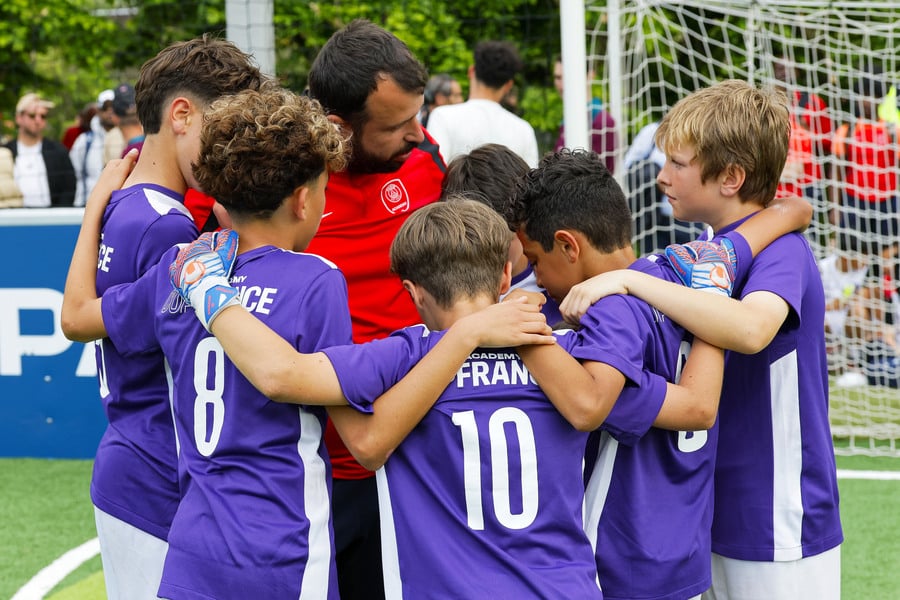
Your child dreams of a football camp in Spain, Italy or France? The idea appeals to you, but one question keeps nagging: how do you prepare them to travel alone to a foreign country? Between excitement and apprehension, this first major trip represents a significant milestone. And you’re right to ask these questions. A study by the American Camp Association found that 96% of children who experienced an overseas camp developed better self-confidence and improved social skills. But for this adventure to succeed, careful preparation is essential. Here’s how to guide your young footballer towards this unforgettable experience, calmly managing the practical, emotional and cultural aspects.

Assessing whether your child is ready for the adventure
Before even booking a residential camp abroad, ask yourself the right questions. Age isn’t the only criterion. Some 10-year-olds are perfectly autonomous, while some 14-year-olds need more reassurance. Focus instead on their emotional maturity.
Have they ever spent a night away from you? At grandparents’, at a holiday camp, at a friend’s house? These prior experiences are excellent indicators. A child who has already slept elsewhere without major difficulty will adapt more easily to a camp environment. If this has never happened, perhaps consider a camp in England first to test their reaction before the big international leap.
Another crucial point: their motivation. Is this really their project or yours? A child who has been begging for months to train at Arsenal or FC Barcelona will have intrinsic motivation that helps them overcome difficult moments. A child being pushed may find the distance harder to cope with.

Preparing for the language barrier without stress
The language barrier worries many parents. That’s understandable. But here’s a reassuring reality: football is a universal language. On the pitch, gestures, demonstrations and the game itself transcend words. Coaches at major clubs are accustomed to working with children from around the world.
That said, some basic language skills make daily life easier. No need for intensive courses, but learn together about twenty essential phrases: asking for food, saying something hurts, asking where the toilets are, expressing a need. Turn it into a game in the weeks before departure. Children remember quickly when it’s fun.
Some camps actually offer programmes combining football and language classes. Double benefit: your child improves on the ball AND in the local language. The PSG camps in London or Manchester City camps offer these popular hybrid options.
Managing separation anxiety (theirs and yours)
Let’s be honest: sometimes it’s the parent who’s most afraid. And children sense this. If you’re anxious, your child will absorb that negative energy. So work on your own peace of mind first before focusing on theirs.
For your child, certain strategies work particularly well. Involve them in the preparation: let them choose certain items for their suitcase, show them photos of the venue, let them virtually discover the facilities. This ownership reduces apprehension about the unknown.
Establish a communication ritual before departure. Not a call every hour—that would be counterproductive. But perhaps a WhatsApp message in the evening before bed, or a call every other day at a set time. This anchor reassures without creating dependency. And plan a transitional object: a family photo slipped into their washbag, a small lucky charm, something that connects them to home without weighing them down.
Departure day: the keys to a successful goodbye
The moment of saying goodbye is crucial. Stay positive and brief. Endless, tearful farewells are the worst enemies of a calm departure. Tell them you’re proud, that you trust them, and that you can’t wait to hear about their adventures. Then leave. The supervisors will take over—it’s their job.
If your child is flying alone, enquire about UM (Unaccompanied Minor) services from airlines. These arrangements guarantee complete care from check-in to handover to an identified adult upon arrival. Major clubs often offer airport transfers included or as an option, as mentioned on camp information pages.

Practical aspects not to overlook
Beyond the emotional, some logistical details deserve your attention. Start with travel documents. For a minor travelling alone within the EU, a valid passport is generally sufficient from the UK. Check destination requirements carefully and prepare any necessary consent letters from both parents.
Health-wise, prepare a basic kit with their usual medications if needed, and share any important medical information with the camp: allergies, ongoing treatments, specific dietary requirements. Residential camps take these elements very seriously and adapt meals accordingly.
For the suitcase, focus on practicality. The camp generally provides a complete training kit (shirts, shorts, socks). Pack outfits for evenings, toiletries, a swimming costume if water activities are planned, and a small cash budget for souvenirs. Label everything. Really everything. Items get mixed up quickly in a group of excited children.
Understanding supervision and safety on site
Parents legitimately worry about safety. Good news: camps organised by major European clubs apply strict protocols. Children are never left unsupervised. Campuses are secured, access is controlled, and the staff-to-child ratio guarantees personalised attention.
At PSG Academy for example, facilities are centralised to limit travel. UEFA-qualified coaches and activity leaders supervise the youngsters 24/7 in residential camps. Security guards control entrances. This level of rigour is found in all the premium camps we offer at Looking For Soccer.
Don’t hesitate to ask specific questions before booking: what is the adult-to-child ratio? Is there medical staff on site? How are emergencies handled? How can you contact your child if needed? A serious camp will answer all these questions without hesitation.
The unexpected benefits of this experience
Beyond football, sending your child abroad alone offers valuable learning. Autonomy first: managing their belongings, following a schedule, adapting to a new environment. Tolerance next: mixing with children from different cultures, hearing other languages, discovering other ways of experiencing football.
Friendships formed during these stays often last. Your child may return with contacts from around the world, shared memories that create strong bonds. And that pride in having succeeded, having experienced something exceptional by themselves. That’s priceless.
Athletically too, immersion in a different football culture broadens horizons. The Spanish methodology isn’t the same as the English, which differs from the Italian approach. Exposing your child to several schools of thought enriches their game and tactical understanding. That’s why many families alternate destinations from year to year.
FAQ: Your questions about football camps abroad
From what age can you send a child alone to a camp abroad?
Most residential camps accept children from age 8-9. But the ideal age depends mainly on your child’s maturity. Generally, 10-12 offers a good balance between sufficient autonomy and appropriate supervision.
My child doesn’t speak the local language at all. Is that a problem?
No. Football transcends language barriers. Coaches use lots of demonstration. And your child will quickly learn the basics through immersion. Some camps offer football + language options to combine both learning experiences.
How will my child travel alone by plane?
Airlines offer UM (unaccompanied minor) services with complete supervision. Camps often include or offer airport transfers as an option. Check with the airline about compatible times.
How do I stay in touch during the stay?
Most accommodations have WiFi. Agree on a daily or every-other-day slot for a message or call. Avoid constant contact which would prevent your child from fully experiencing their adventure.
What happens if my child falls ill or gets injured?
Serious camps have first-aid trained staff and emergency protocols. They will contact you immediately if there’s a problem. Check your insurance covers treatment abroad and carry a valid GHIC card for EU stays.
My child is homesick. How should I respond?
This is normal in the first few days. Supervisors are trained to support these moments. During your exchanges, stay positive, encourage them to enjoy themselves, and remind them it’s temporary. In 90% of cases, it passes within 24-48 hours once they’ve made friends.
What budget should I plan for a camp abroad?
Prices vary depending on destination and club. Expect between £1,300 and £2,200 for a week’s residential stay at a major European club, excluding transport. More accessible options exist, particularly summer camps at private academies.
Sending your child to a football camp abroad represents an act of trust—in them and in yourself. This experience, well prepared, becomes a springboard towards greater autonomy, confidence and openness to the world. And when they return, eyes sparkling and full of stories, you’ll know you made the right choice. Ready to offer them this adventure? Discover our camps in Europe and find the one that matches their dream.